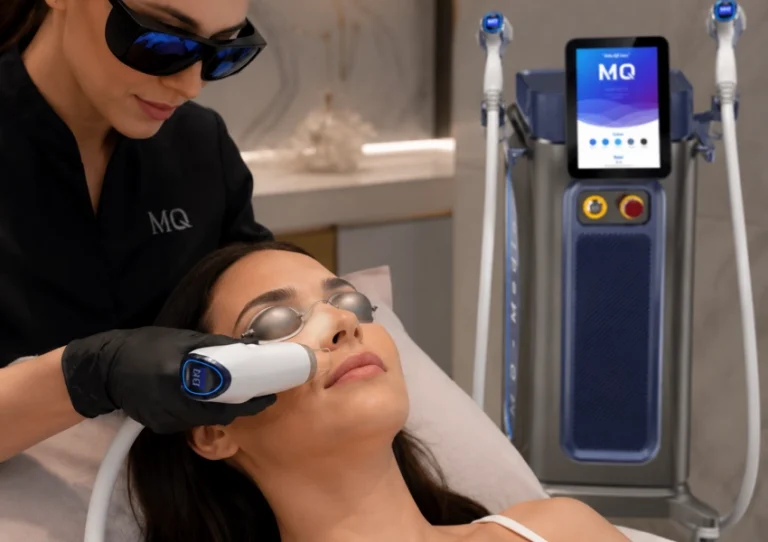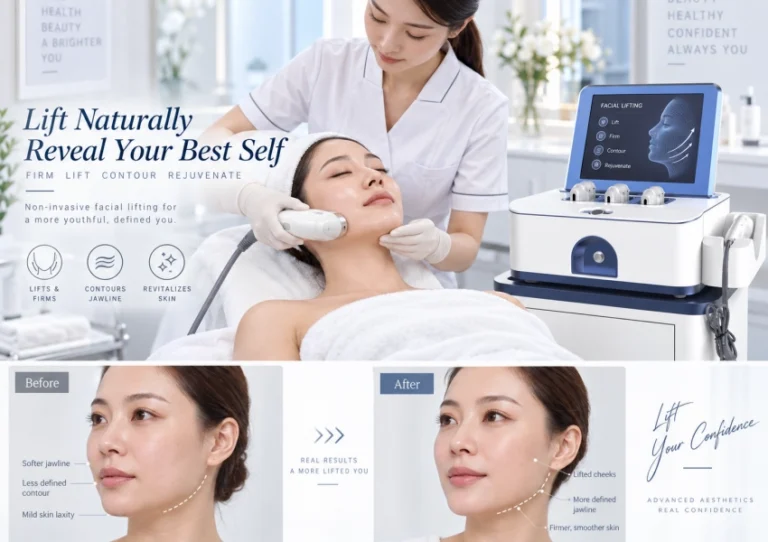
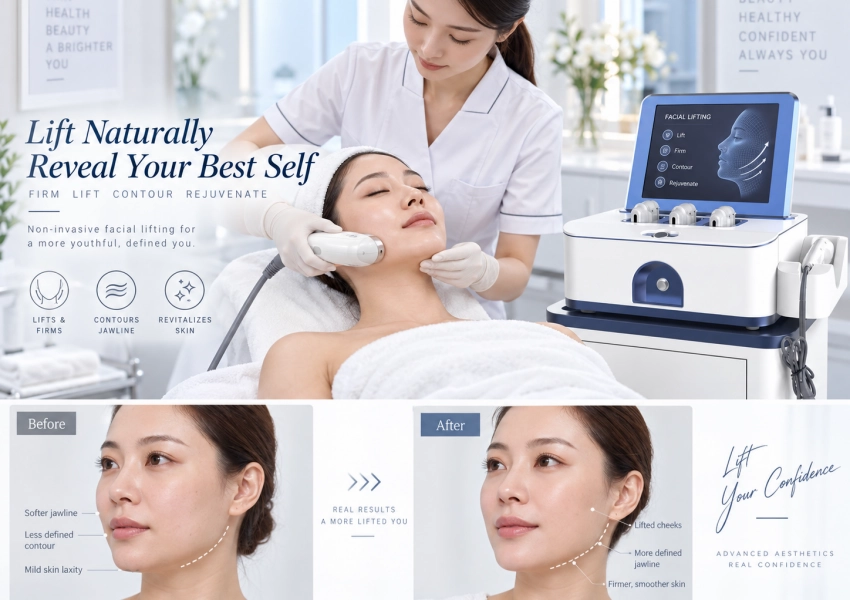
A jawline service can become one of the most useful anchor treatments in a facial contouring menu, but only when the clinic sells the full process rather than a single dramatic claim. HIFU jawline work involves consultation, skin laxity assessment, cartridge selection, treatment mapping, discomfort management, photography, follow-up, and realistic timing. A high-value menu makes those steps visible to the client.
The term “HIFU face lift” is widely used in the market, yet a clinic still needs to define what the service can and cannot address. HIFU can create focused thermal coagulation in selected tissue depths. It does not replace surgery, correct every type of facial volume loss, or guarantee a sharp jawline when the main issue is heavy skin, bone structure, or substantial adipose tissue.
Why the Jawline Needs a Structured HIFU Protocol
The lower face is not a flat treatment field. The jawline, lower cheek, submental area, and upper neck have different tissue thicknesses and different anatomical risks. A professional HIFU device should therefore support more than one cartridge depth and should be used with a treatment map that identifies safe zones and areas requiring extra caution.
Match Critical Depth to the Target Layer
The commercial HIFU reference separates 1.5 mm for superficial skin quality, 3.0 mm for deeper dermal collagen work, and 4.5 mm for the SMAS-related facial lifting layer. Longer cartridges from 6.0-13 mm are generally associated with body applications, not routine jawline work. These depths are planning references. Actual treatment requires the manufacturer’s validated protocol, local scope of practice, and trained professional assessment.
| Cartridge depth | Planning role | Jawline menu use |
| 1.5 mm | Superficial skin and texture work | Fine lines, surface quality, selected finishing work |
| 3.0 mm | Deeper dermal tightening | Lower cheek and skin laxity programs where appropriate |
| 4.5 mm | Deeper structural lifting target | Jawline and lower-face contouring when anatomy permits |
| 6.0-13 mm | Subcutaneous body applications | Usually kept for body contouring, not routine facial mapping |
A strong menu does not use every depth on every face. The operator should consider facial thickness, fat distribution, bony prominence, prior filler or threads, nerve pathways, and the client’s objective. A slim face with little subcutaneous volume may need a very different plan from a fuller lower face.
Turn HIFU Jawline into a High-Value Service Menu
A high-value service is easier to sell when it has a clear beginning, middle, and follow-up. One practical structure is an assessment visit, a mapped treatment, and scheduled photography at one, three, and six months. The clinic can then discuss progressive collagen remodeling without promising an instant surgical effect.
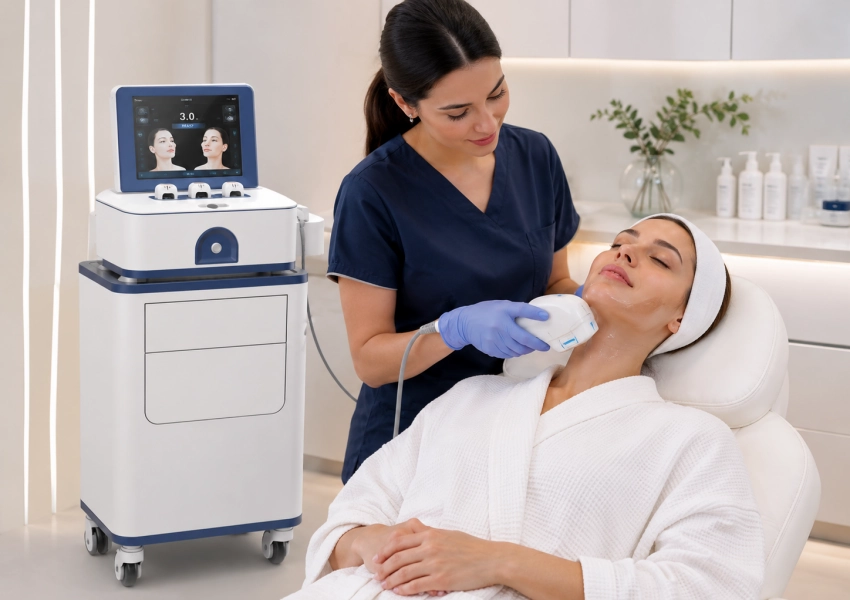
Three Menu Levels Work Better Than One Generic Treatment
A clinic may offer a focused jawline session for clients with mild laxity, a lower-face and neck contouring plan for a wider treatment area, and a premium facial contouring program that combines HIFU with a separate skin-quality or injectable pathway. Each level should state the area, expected appointment length, cartridge plan, follow-up, and what is excluded.
The HIFU facelift machine is described with 1.5 mm, 3.0 mm, and 4.5 mm facial depths, plus longer body options. That kind of cartridge coverage can support a menu with different tissue targets, but the clinic should confirm the supplied handpieces, shot count, energy range, cartridge life, and local documentation before advertising a professional HIFU device.
Price the Service Around Time and Consumables
A jawline service price should include consultation, operator time, consumable shots, cleaning, photography, follow-up, payment fees, and room opportunity cost. Cartridge cost is only one line. A low price can damage margin if the treatment takes longer than expected or if the clinic repeats areas because the map was not clear.
The business can also separate a first treatment from a maintenance visit. The interval should follow the clinical protocol and patient response, not a blanket monthly subscription. A follow-up appointment can include assessment and photography without automatically triggering another energy-based treatment. That makes a HIFU face lift menu more credible because timing is tied to reassessment.
Safety and Patient Selection Protect the Menu
A facial contouring device should be introduced with a screening form. The clinic needs to ask about pregnancy, active infection, open wounds, implanted electronic devices, metal or other implants in the treatment field, recent threads or fillers, active inflammatory skin disease, and medicines that may affect treatment decisions. The exact exclusions depend on the device, operator, and local rules.
Jawline treatment also requires careful mapping around the mandible, temporal area, salivary structures, and nerve pathways. The supplied handbook advises continuous movement, adequate coupling gel, avoidance of repeated high-energy passes, and special care over bony areas. These are safety-oriented operating concepts, not a substitute for formal training or an approved protocol.
| Menu component | What the clinic should define | Why clients value it |
| Assessment | Laxity, volume, skin thickness, medical history, prior procedures | A clear plan feels more credible than a generic shot count |
| Treatment map | Area, cartridge depth, line direction, energy limits, no-go zones | Explains why the service is customized |
| Follow-up | Photography at agreed intervals and response review | Sets expectations for gradual change |
| Maintenance | When reassessment is appropriate; what is not repeated | Avoids over-treatment and protects trust |
Choosing a HIFU Machine For Clinic Growth
A buyer comparing a HIFU machine for clinic use should look beyond the number of cartridges. Confirm the depth, focal distance, shot counter, cartridge lifespan, energy consistency, interface, treatment presets, emergency stop, handpiece replacement, warranty, training, and after-sales response. Ask whether the supplier can provide English materials, treatment maps, and a service record template for the target market.
The HIFU equipment can be reviewed alongside the clinic’s menu. A small facial studio may need a compact facial-only configuration. A larger med spa may want body cartridges, faster handpiece changes, and a reporting process that supports multiple operators. The correct professional HIFU device is the one that can be used safely and booked profitably in the actual room. The facial contouring device should support the service map, documentation, and follow-up process rather than exist as a standalone cabinet.
A facial contouring service also benefits from supplier support that is specific to the local business. MQLASER company information describes the supplier context behind its equipment portfolio. The scope, documentation, certification, and training format should be written into the purchase agreement rather than assumed from a catalogue page.
MQLASER is the natural starting point for requesting current cartridge options, machine configuration, and export documents. Build the menu first, then choose the device that can deliver it with clear boundaries, trained staff, and traceable follow-up. If you would like to learn more, please read this article.
FAQ
Q1: Can HIFU sharpen every jawline?
A1: No. The result depends on skin laxity, tissue thickness, fat distribution, facial structure, age, and treatment technique. Consultation is essential.
Q2: Which cartridge depths are commonly considered for the face?
A2: Commercial systems commonly list 1.5 mm, 3.0 mm, and 4.5 mm facial depths. The correct choice depends on the anatomy and the validated device protocol.
Q3: What makes a HIFU menu high value?
A3: Clear assessment, mapped treatment, appropriate cartridge selection, realistic follow-up, transparent pricing, and trained staff make the service more valuable than a generic shot-count offer.