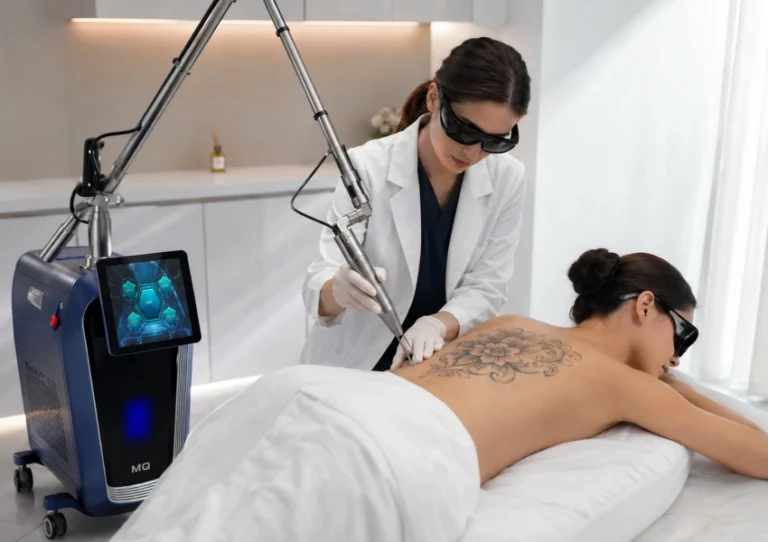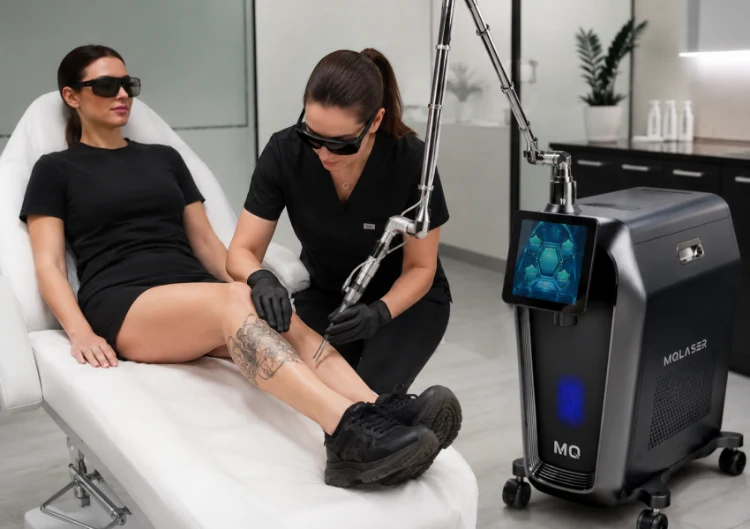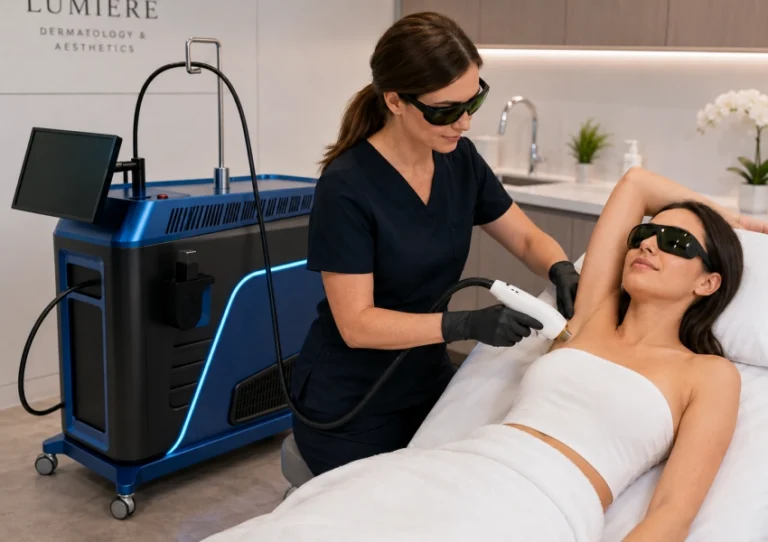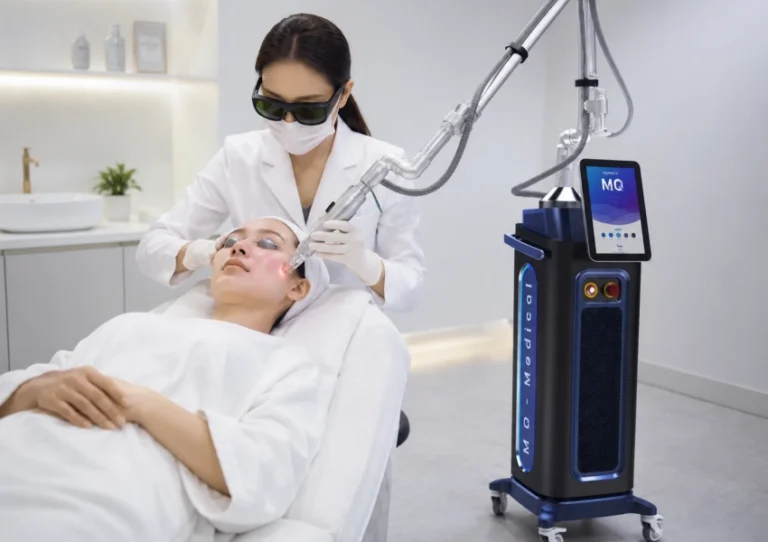
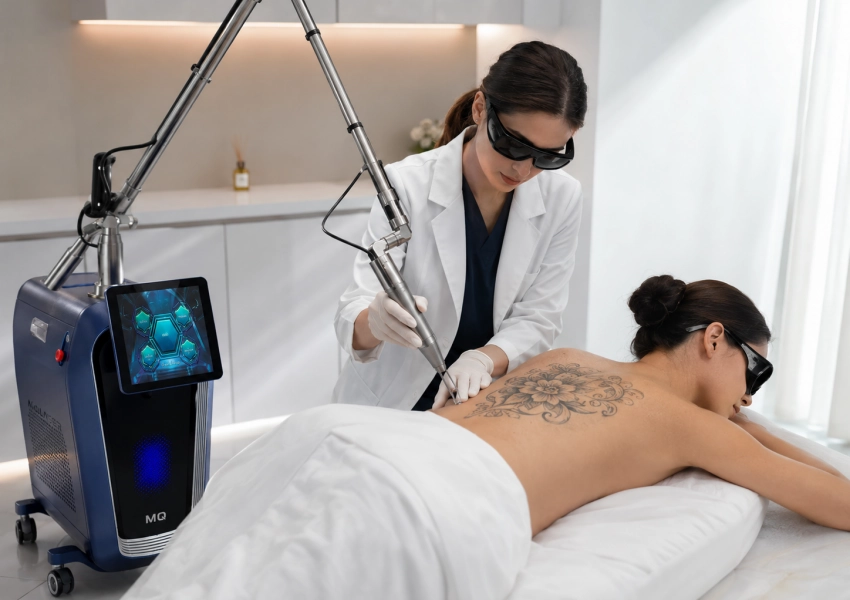
A new clinic often asks a simple question: should the first pigment platform be a premium picosecond laser or a more configurable device such as DEPELITE? The answer depends on the first twelve months of bookings. Tattoo removal, cosmetic tattoo correction, freckles, age spots, vascular redness, and skin rejuvenation do not place the same demands on a machine. A tattoo removal laser machine also needs to fit the clinic’s local pigment mix.
This comparison uses picosecond laser vs Q-switched laser and pico laser vs Nd YAG as practical buyer language, but the buying decision comes down to pulse behavior, wavelength coverage, staff capability, local service, and cash flow. DEPELITE is listed as a 350 ps real picosecond platform with 1064 nm and 532 nm standard wavelengths, SP, PTP, and MP modes, 2-10 mm adjustable spots, and more than 30 self-check points. The same configuration can be presented as a pigmentation removal machine when the menu includes freckles and age pigment.
Start With the First Service Line, Not the Brochure Name
A clinic built around black tattoo ink and cosmetic eyebrow correction may prioritize 1064nm output, reliable beam delivery, and clear operator training. A clinic that expects more freckles, superficial pigmentation, red pigment, and skin-quality requests may need 532nm, dual-pulse operation, and a broader menu. The first machine should cover the cases that can actually be sold in the local market.
Picosecond and Q-switched Platforms are Not Interchangeable
Both technologies use short pulses to target pigment, but pulse width and energy delivery change the balance between photomechanical effect and heat. Q-switched Nd:YAG systems are established for many pigment and tattoo applications. Picosecond systems use even shorter pulses, which can be useful when the treatment plan depends on breaking pigment into smaller particles with less thermal spread. That does not make every picosecond treatment faster or suitable for every lesion.
| Factor | General premium picosecond platform | MQLASER DEPELITE |
| Standard wavelengths | Configuration depends on the model and handpiece | 1064 nm and 532 nm |
| Pulse width | Often picosecond; exact value must be verified | 350 ps listed |
| Modes | Varies by platform and software | SP, PTP, and MP |
| Spot size | Depends on handpiece and optic | 2-10 mm adjustable |
| Extra configuration | May be limited to standard brand packages | 755 nm, 1320 nm, 585 nm, and 650 nm options listed as customization |
| Best first-clinic fit | Brand-led premium positioning | Broader service menu with factory configuration support |
The phrase pico laser machine price is useful when comparing budgets, but the purchase price is only the first number. A new clinic should also model handpiece replacement, calibration, training, consumables, warranty, shipping damage, and the time required to build a safe treatment menu. A lower quote is not useful if the platform cannot support the cases that generate local demand.
Why DEPELITE Can Make Sense as a First Device
DEPELITE has a useful entry point for a new clinic because it is not limited to one narrow project. SP mode is listed at 50-1200 mJ for 1064 nm and 20-600 mJ for 532 nm. PTP mode is listed at 300-2400 mJ for 1064nm, while MP mode reaches 500-3000 mJ and includes a maximum 4J per pulse with a 25 microsecond interval. These figures describe the product range, not treatment instructions.
One Cabinet Can Support Several Early Services
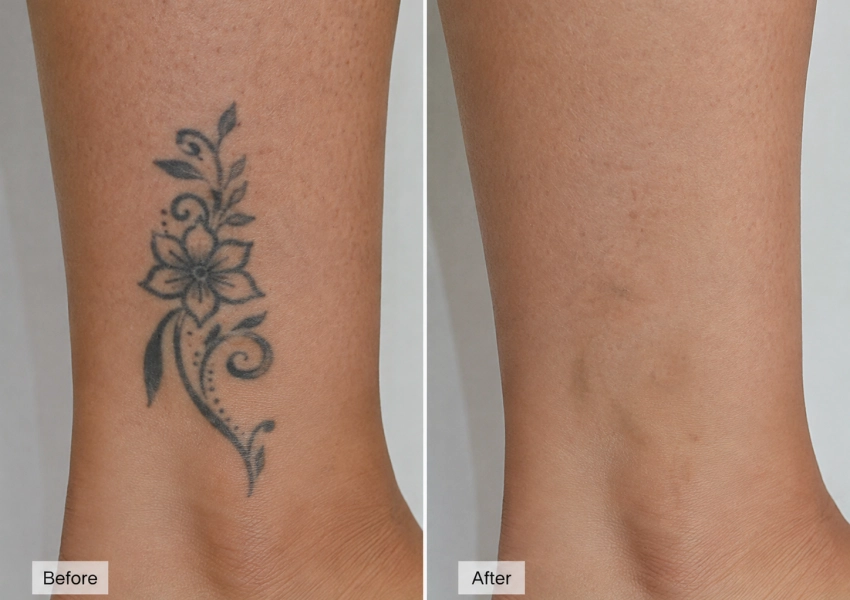
A new clinic can build an initial menu around black and dark tattoo removal, cosmetic tattoo correction, freckles, age pigment, selected vascular concerns, and skin rejuvenation. The device’s user interface includes suggested parameters for eleven common treatment items. That can shorten the time needed to create internal service sheets, although trained practitioners still need to assess skin type, pigment depth, contraindications, and recovery risk.
The 7-joint arm, adjustable optical lattice, uniform light distribution, and self-check system also matter during the first year. A small team cannot afford a complicated device that only one senior operator can use. More teachable hardware helps the clinic schedule treatments across rooms, document settings, and make follow-up comparisons easier.
The DEPELITE picosecond laser is listed at 1800 W, 1-10 Hz, 20-3000 mJ, 110V/220 V, and 110 kg. The final configuration should be confirmed before purchase, especially for voltage, wavelength options, spot accessories, and export documentation.
When a Premium Picosecond Platform is the Better First Buy
A premium platform may be the better first machine when the clinic already has a strong dermatology referral network, can charge a brand-led price, and expects clients to ask for a specific device by name. It may also be appropriate when a medical director wants a narrowly defined treatment system backed by established training and a familiar service pathway.
The downside is capital pressure. A new clinic has rent, staff, marketing, compliance, consumables, and patient acquisition costs before the pigment room reaches steady utilization. If the machine is expensive but the local booking mix is still uncertain, the clinic may delay its second service line and place too much pressure on tattoo revenue alone.
The Decision Should Follow a Twelve-Month Booking Map
List the expected split between tattoo removal, cosmetic tattoo correction, pigmentation, and rejuvenation. Add the skin tones and ink colors most common in the target area. Then ask whether the platform has the wavelengths, spots, cooling, training, and service support to cover those cases. The picosecond laser category can help compare configuration routes, but it should not replace a local demand estimate.
| Business question | Premium picosecond route | DEPELITE route |
| Capital use | Higher investment may support premium room pricing | More room to preserve cash for staff and marketing |
| Service breadth | Strong when the model is configured for the clinic’s main indications | SP/PTP/MP modes and optional wavelengths broaden the menu |
| Training | Brand-led education can be a major advantage | Preset suggestions and self-check points support a teachable workflow |
| Customization | Usually more standardized | OEM/ODM, interface, cabinet, wavelength, and market support to confirm |
| Channel growth | Best for a clinic-first strategy | Suitable for clinic, distributor, and private-label strategies |
A Careful First Purchase Beats a Dramatic Launch
The first device should be judged by the cases it can handle repeatedly, not by the longest list of optional claims. A clinic that wants premium brand pull may choose a high-end platform. A clinic that wants a manageable first cabinet with several pigment services may choose DEPELITE. The same logic applies when comparing a pico laser vs Nd:YAG system: pulse width matters, but so do wavelengths, software, safety controls, operator competence, and service access.
Before signing, request a written configuration, training schedule, spare-parts list, warranty terms, and sample treatment documentation. Also ask how the supplier handles parameter updates and technical questions after installation. The pico laser machine price should be judged alongside those support costs. MQLASER offers product training, distributor support, marketing support, and after-sales service for the DEPELITE route; exact scope should be written into the order.
A new clinic does not need to buy the most expensive device first. It needs enough capability to build safe, repeatable demand and enough supplier support to turn early appointments into a stable service line. The picosecond laser vs Q-switched laser debate and the pico laser vs Nd YAG comparison should be judged in that same twelve-month context, alongside the needs of the tattoo removal laser machine and pigmentation removal machine services. The MQLASER picosecond treatment guide is another relevant product-education reference for the first protocol discussion. For more information, please do not hesitate to contact us.
FAQ
Q1: Is a picosecond laser better than a Q-switched Nd:YAG for every tattoo?
A1: No. Results depend on ink color, depth, skin type, wavelength, fluence, spot size, treatment interval, and operator judgement. Technology alone does not determine the outcome.
Q2: Why is DEPELITE suitable for a new clinic?
A2: Its standard 1064 nm and 532 nm wavelengths, three operating modes, adjustable spot, and preset suggestions can support several early pigment and skin-quality services.
Q3: What should be included in a pico laser purchase quote?
A3: Confirm wavelengths, pulse width, energy range, spots, cooling, training, warranty, spare parts, software language, certification documents, and after-sales response.