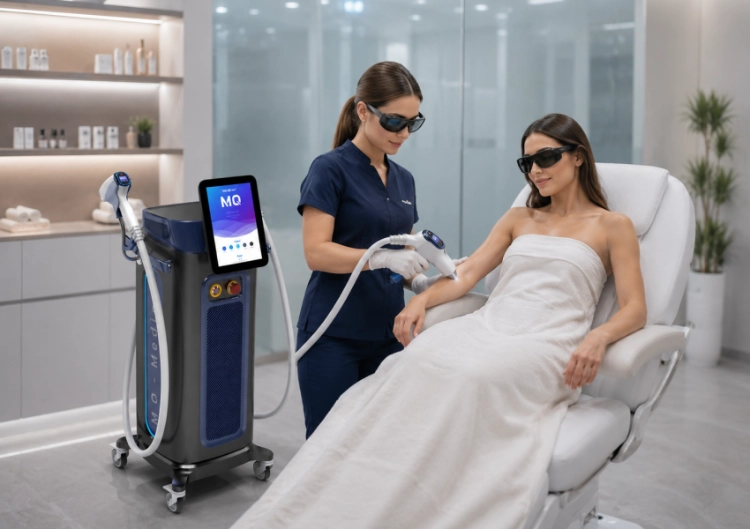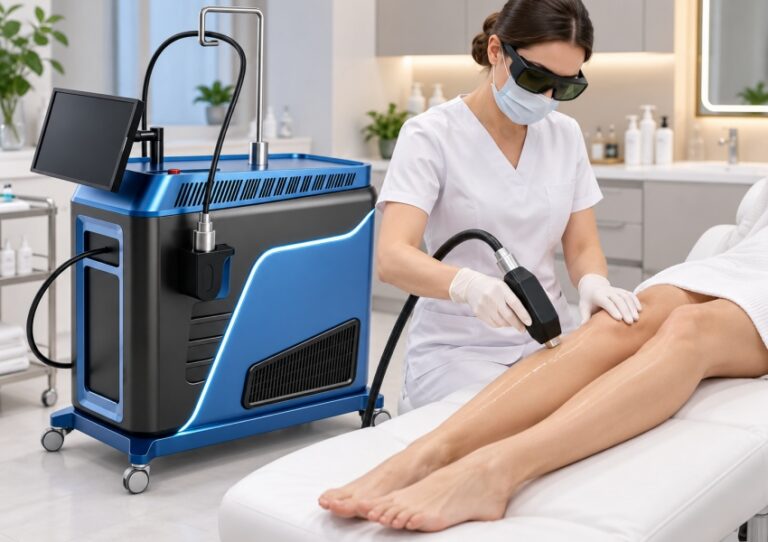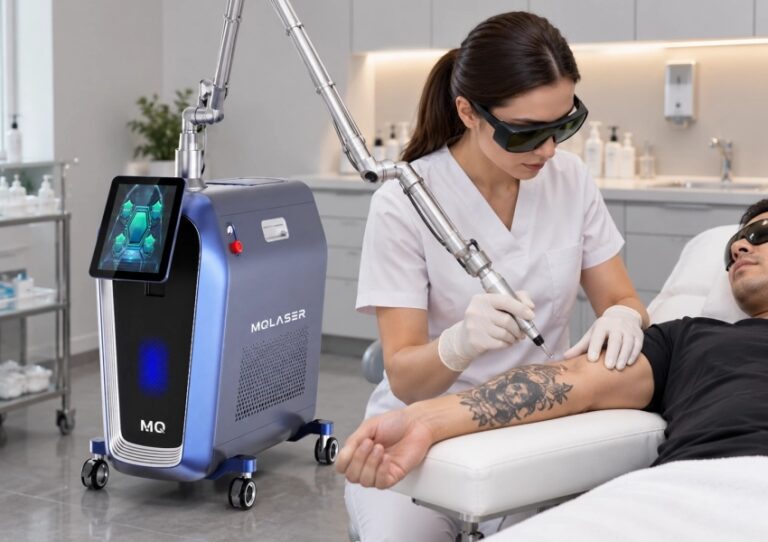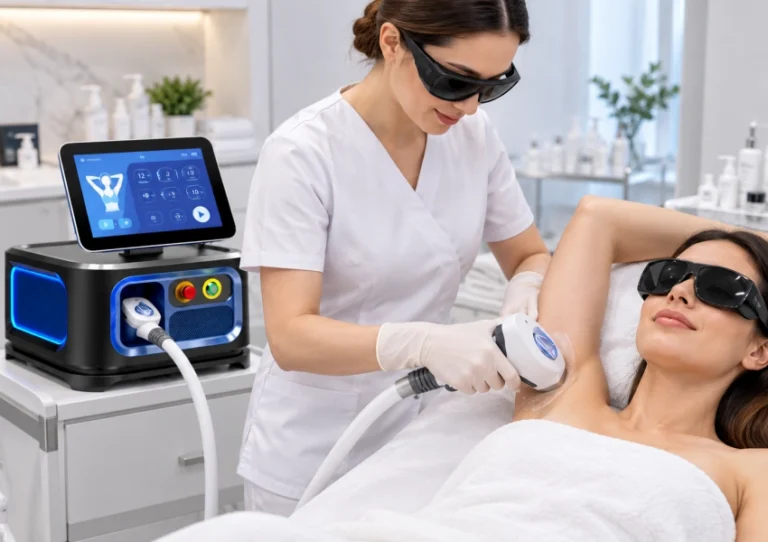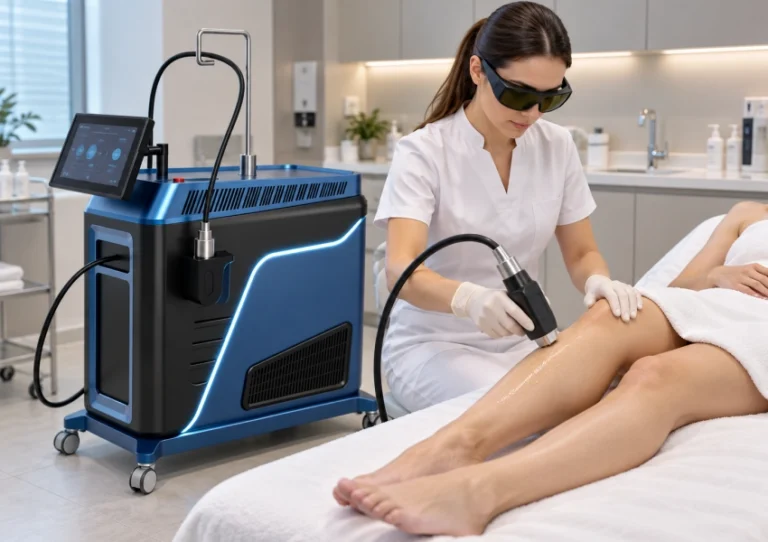
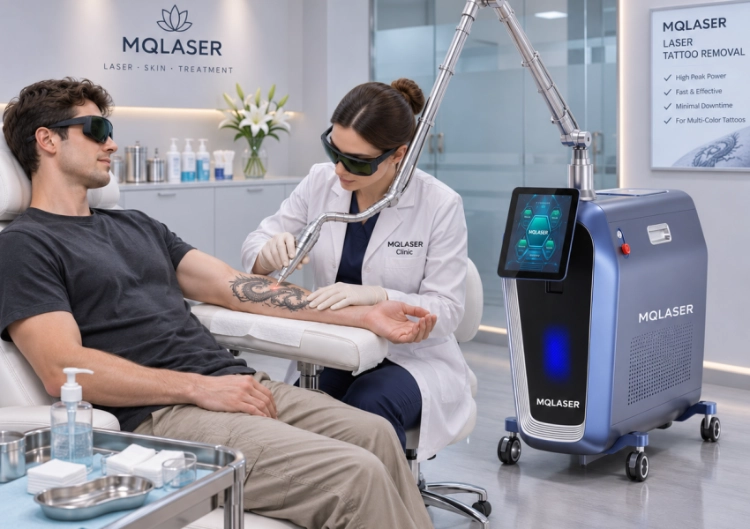
Since tattoo removal colors behave differently under a laser from how they are in their salt forms. The response is influenced by pigment chemistry, optical absorption, and properties (depth, density & layering), as well as skin tone. A black tattoo may trace a pathway associated with different wavelengths than the green, red, yellow, or cosmetic pigment. The setting should use the ink that was established beforehand rather than promise a picosecond label to repair every shade.
Although a picosecond laser allows for shorter pulse delivery to the targeted pigment, service is still contingent on wavelength and spot size as well as fluence, beam quality, and skin assessment, along with healing intervals. The DEPELITE has 350 ps, 532 nm & 1064 nm routes; SP∙PTP∙MP modes; and a list of various spots: 2 ∼10 mm.
Color Changes the Wavelength Question
A common approach for dark black and dark blue inks is using a 1064 nm route, since the longer wavelength penetrates deeper in the skin tissue, where most of the pigment-rich epidermis melanin has relatively low absorption than that at visible wavelengths. Red, orange, and some yellow pigments can be reached with 532 nm, although epidermal melanin absorbs more at this shorter depth, which warrants higher caution, especially on darker skin. Green, blue, green, turquoise, and mixed colors in varying degrees may react differently—some even require a different wavelength or need to be done as part of a sequenced plan.
The ink color is just a visual indicator. If you have professional tattoos, many pigments in them or cover-ups may hide multiple. In addition to this, some compounds lighten after laser exposure but darken and become visible again with time, as the cosmetic ink remains under the skin over years. Note whether it is a professional or amateur tattoo and the type of tattoo (e.g., an amateur or cosmetic tattoo or cover-up). Inquire about past sessions (wavelength, interval), blistering/pigment change/scarring, before modifying the regimen.
Why Green and Red Can Be Difficult
Green tattoo removal is often more difficult than any other color because a single green ink may contain multiple different pigment types, each with unique absorption properties. An expanse of turning leaves may one way seem yet not function; that means. Tattoo removal methods for the red color are going to be mixed since sometimes, the pigment used within remains in multiple forms of yellow or orange, and some cosmetic pigments simply could mother nature. It’s best treated as if it were two materials: safety in testing a small area first and why wait to see the entire presentation all at once.
A clinic: (1) photograph—even a standardized time and distance in uniform lighting conditions, ideally studio-quality photo copy would be employed rather than controlled post-session glare control photography—(2) segment any larger design pictographically into pre-lettered areas to facilitate easier diagnosis of pattern segments, e.g., A-C panels could produce wider data adoption with 9 sections for eye type superimposed on an identical numbered figure. Though whitening can happen instantly, continually working towards this dramatic endpoint with several overlaps just increases undue pressure on the tissue. It has a long follow-up period for the inflammation and crusting to settle.
Skin Tone and Ink Depth Matter as Much as Color
Epidermal melanin has been found to have a stronger absorption for visible wavelengths; therefore, darker phototypes may necessitate more conservative planning with 532 nm. Several factors affect the timing: recently tanned skin or alteration of pigmentation, any active inflammatory processes, or limitations in aftercare capacity. The client should be given instructions for the practical cleansing, covering up between procedures if exposure is anticipated like sun activities or picking, and signs to have reviewed.
Darker, denser, or layered ink often requires additional time and extra trips. Far away spots might heal in different ways than the trunk, and a thick covering may expose an additional color after the leading layer disappears. If a plateau is observed in the response, adjust ink composition and wavelength pairings—energy increase does not affect outcome. From color alone, you cannot promise a complete clearance.
If a multicolor design is mapped prior to the first session, this simplifies treatment planning. Take a photo of the complete tattoo, demarcate color zones in the treatment record, and note which areas will be treated at specific wavelengths or left for test spots. If the red color is next to the black linework, the operator should not carry one of the settings across both pigments just for expediency. Compare each zone separately, noting fading at follow-up (zone 1 vs. other zones), texture, pigment change, and healing time. When one color responds and another is left visible, this record can direct a staged plan.
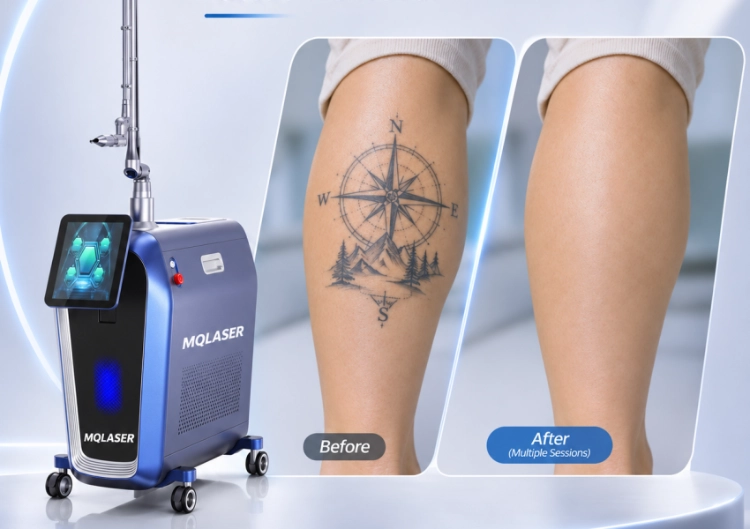
Make DEPELITE Part of a Documented Workflow
DEPELITE will provide the multi-color tattoo and pigment service, pending confirmation of the exact unit/handpiece/mode/training package as illustrative in the classification. Inquire about delivered pulse duration, fluence at each spot size, beam profile, output stability requirements, calibration with standards, and/or by others’ control via software warranty service response time. The configuration review should be wider for a picosecond laser category, and the final purchase order needs to identify the package delivered.
Dust and facial flushing history, as well as ink colors, tattoo dimensions (length × width in inches), skin type, previous treatment if any performed by another physician or a family member with selected wavelength super mac pht8 mm spot – 1.5/3 ms pulse of each color at the level Z fluence/l/n, passes ~7, endpoint ~10% crusting of treated area, interval between treatments, and healing following laser-treatment response should also be recorded in one form. Team members need to know when they should stop, who needs delaying another session and at what point a sustained reaction passes through into the clinic’s defined review track. But that shorter pulse is only valuable within the context of that larger assessment and follow-up system.
The following practical part of a session starts well with confirmation that you have tattooed and how long it has been since their previous treatment was completed, ensuring that the skin has had no residual crusting, tenderness, or pigment alteration, etc. It allows the operator to take photographs and measure targets, verify eyewear as well as room setup, and only treat pre-chosen zones by color. Note any immediate whitening or pinpoint bleeding as an observation only and not evidence that the pigment has cleared. Written instructions for what to do based on cooling, cleansing, sun protection, and no picking; setting a review date when skin has settled.
DEPELITE Customer Applications and Market Opportunities
The technology is a picosecond laser that could help in treating tattoo removal and certain pigmentation treatments. Maria Aires Med Spa in New York, USA, & Clinic Medellín purchased the equipment for their clinic. This equips both clinics to market these services within their local communities via patient consultations, instructional videos, social media activity, and consented before–after outcome photos. Purchaser of DEPELITE: Soupelli, a Brazil-based aesthetic equipment supplier to commercial buyers. The market of aesthetic devices in Brazil is projected to reach more than USD 213.5 million by 2026, which can serve as a target for infrastructure supply businesses applied to dermatology clinics, aesthetics centers, and tattoo removal businesses. DEPELITE offers two additional comprehensive 1064 nm and 532 nm wavelengths, along with multiple operating modes supported by in-house technical support for distributors—practical selling points to the local market.
Turn Color Education Into Local Marketing
A local tattoo removal pages are typically also attracting better inspections because they can explain why colors require different treatments. Skip straight to the end, and without reading further, you should know that short videos can illustrate black ink planning vs. red, almost absent of somewhere, just pie-in-the-sky-like results. Your consultation forms should include questions about the age of the tattoo, color, cover-up history, and previous laser treatments, along with skin changes. Photographing of the same body part from progress photography sessions, where results are consented to, and not one that is indicative of a final transformation.
If DEPELITE is a product added for clinics, the content may be grouped in categories such as black and dark-blue tattoos, red and orange pigments, challenging green areas of treatment outcomes, and cosmetic-pigment response. MQLASER‘s product support, OEM/ODM ability, R&D capability, and international certification info can be put in the latter supplier section instead of being used for clinically suitable replacement. The configuration and training scope delivered to buyers can be verified by using MQLASER. For more detail, see our guide on this article.
FAQ
Q1: Is green tattoo removal always harder?
A1: It can be more variable because green inks may contain mixed pigments with different absorption behavior.
Q2: Which wavelength is commonly used for red tattoo removal?
A2: 532 nm is commonly considered for red, orange, and some yellow pigments, but the exact plan depends on ink and skin.
Q3: Can a picosecond laser remove every color?
A3: No. Ink chemistry, wavelength match, skin tone, depth, density, and healing response all affect the outcome.