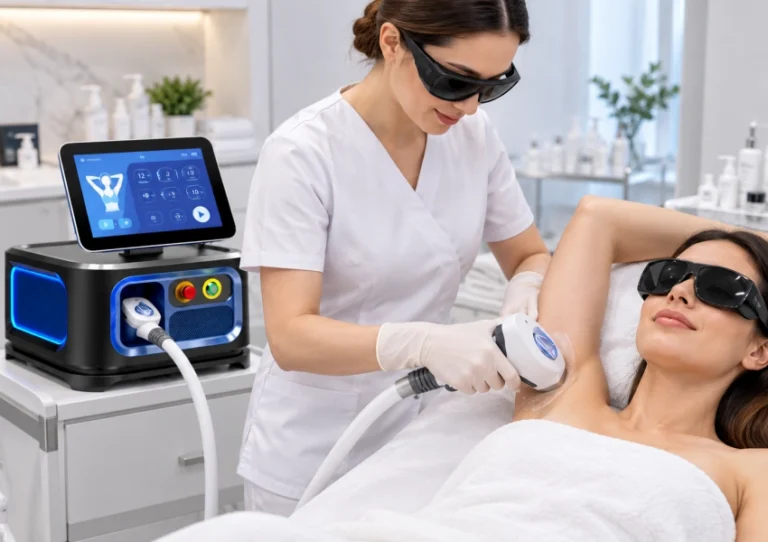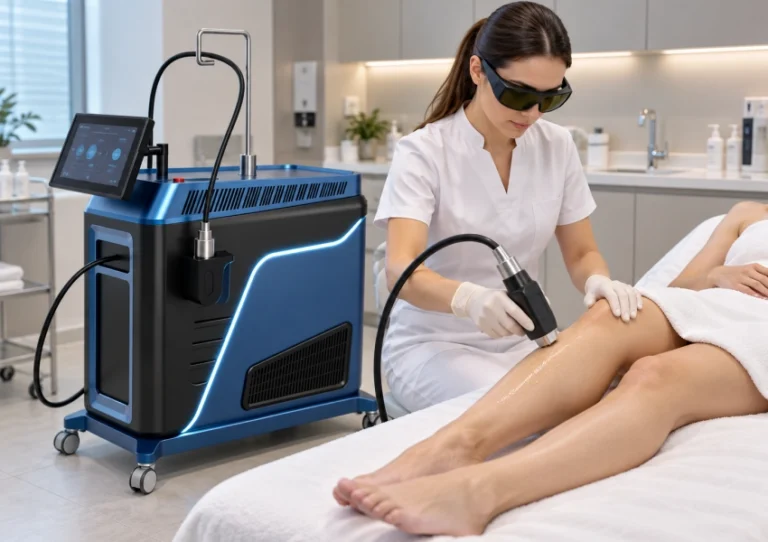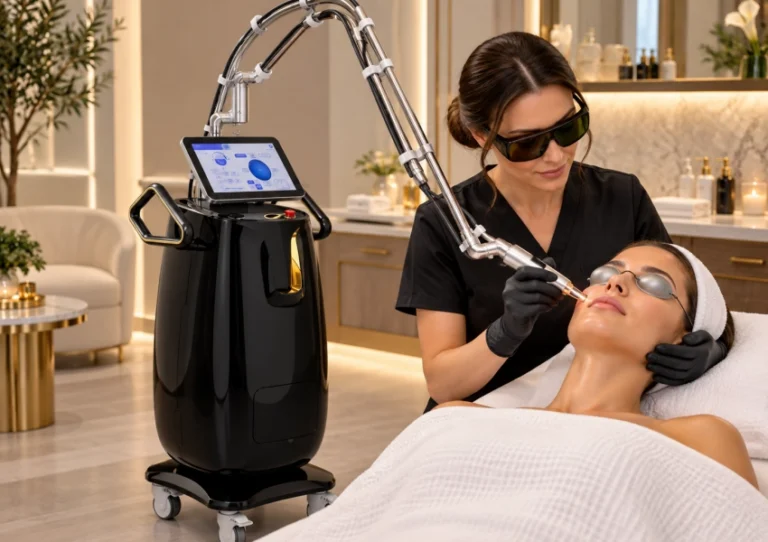
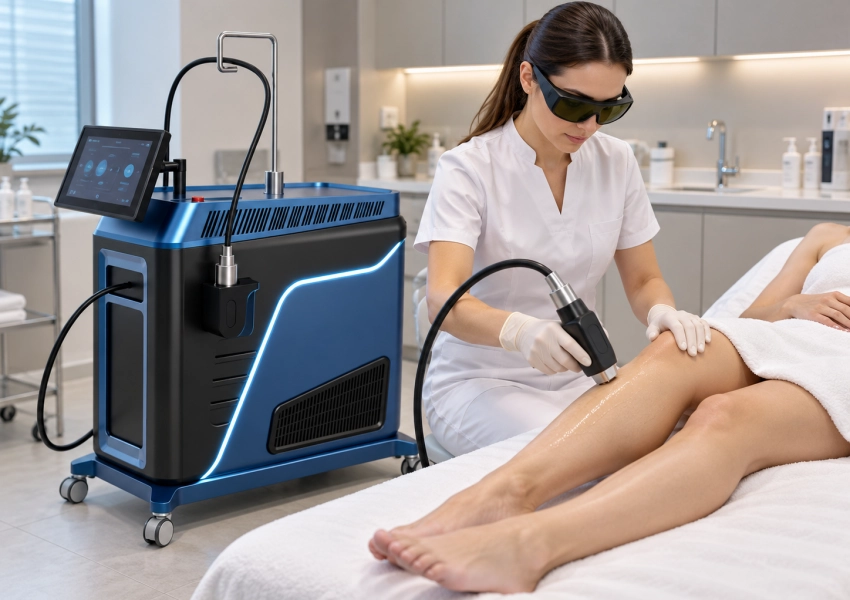
Two hair-removal systems can offer similar wavelength numbers and feel quite different to operate. With Alma Lasers Soprano Titanium, the discussion usually begins with multiple in-motion passes. It also includes diode delivery and contact cooling. AlexPlus uses a different method. Showing two treatments is a 755 nm Alexandrite channel paired with a 1064 nm long-pulsed Nd:YAG channel. The key consideration for any clinic would be the types of treatments they offer and the makeup and experience of their staff. Additionally, there are a number of indications that the device would need to be licensed to treat.
The product versions matter here. Soprano Titanium has simultaneous 755/810/1064 nm delivery, SHR In-Motion, Stack and Classic modes, ICE Plus cooling, and a 4 cm² Quattro applicator. It also has a 2 cm² Trio applicator and positioning across Fitzpatrick skin types I–VI for a special-edition configuration. Those accessories cannot be assumed to ship together. AlexPlus has 755 nm Alexandrite and 1064 nm long-pulsed Nd:YAG. , and also note a maximum spot diameter of 26 mm for a recent Plus configuration and a 2 ms pulse option. The quoted generation and its handpieces need to be identified before those figures are compared.
A Diode Pass and a Selective Laser Pulse Feel Different in the Room
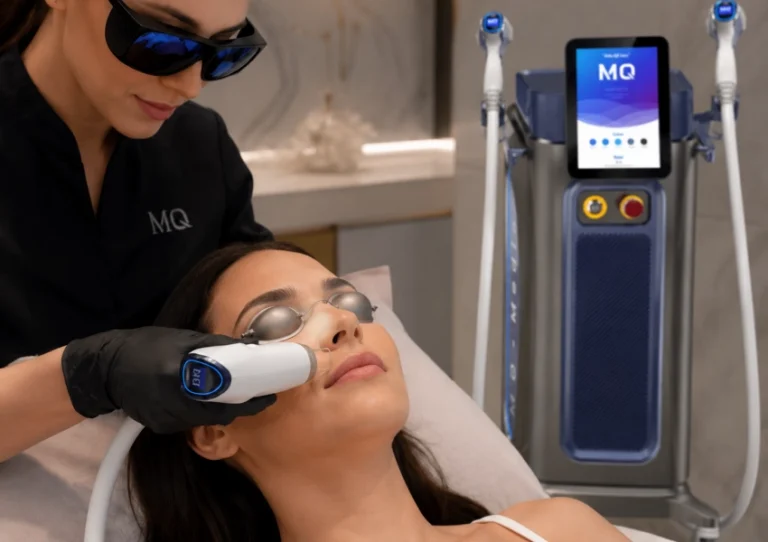
SHR-style in-motion diode treatment uses successive moving passes with cooling and a controlled build-up of delivered energy. That can suit large, repetitive hair-removal services when the operator maintains consistent coverage. Stationary diode modes remain different again. Overlap and spot placement need close attention. AlexPlus uses selective pulses from its Alexandrite or Nd:YAG channel. While the number of wavelengths offered by a device is an important factor, the actual spot size and settings for any given treatment would typically be chosen on a treatment-by-treatment basis, and one technique is not inherently quicker or gentler than another, and there are a number of factors that contribute to treatment time, including movement pattern, cooling, anatomical access to the area to be treated, and quality of end results.
While the wavelengths of 755 nm and 810 nm are commonly associated with hair removal of lighter skin types and coarser hair, respectively, the 1064 nm long-pulsed Nd:YAG is known for its deeper penetration and lower absorption by epidermal melanin, making it suitable for darker skin types and coarser, deeper-seated hair follicles. However, the safety and efficacy of any treatment is determined by the labeling, pulse parameters, patient-specific factors, and assessment by the clinician, not just by the manufacturer’s wavelength list.
| Comparison point | Soprano Titanium | AlexPlus |
| Laser architecture | Diode with 755/810/1064 nm simultaneous delivery in trio configuration | 755 nm Alexandrite + 1064 nm long-pulsed Nd: YAG |
| Delivery modes | SHR In-Motion, SHR Stack, and HR Classic are described in current platform materials. | Selective long-pulsed delivery; exact pulse and spot options depend on generation. |
| Spot data | 2 cm², Trio precision, and 4 cm² Quattro: current special edition lists additional applicator options. | Up to 26 mm maximum spot. |
| Cooling | ICE Plus sapphire contact cooling | Dynamic cryogen cooling is described in the AlexPlus project. |
| Best workflow discussion | Large-area repetitive coverage and standardized moving technique | Wavelength/spot selection for varied hair and skin profiles |
The Patient Mix Should Shape the Purchase Brief
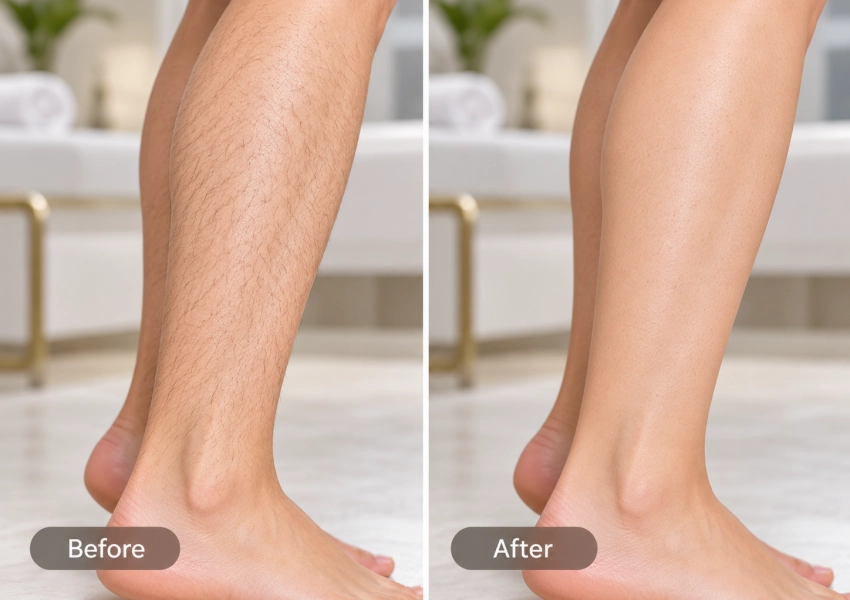
An all-day schedule of lower-leg treatments makes different demands from a clinic dealing with smaller facial areas and clients with varied skin histories. Review the patient mix prior to demonstrating the device. This includes the patients’ Fitzpatrick phototypes, their hair color and type, their tanning history, past hair removal results, and any medications or photosensitizing ingredients that they may be using. White, grey, and some very light or red-haired individuals have very limited melanin for hair removal and therefore may not provide the best return on investment for demonstrations. Individuals with recently tanned skin as well as individuals who are prone to post-inflammatory hyperpigmentation also need to be screened under the approved clinical protocol for the device.
The device may appear to be very versatile, but in reality it will only have a number of approved indications for hair removal as well as authorized vascular and benign pigmented indications, which may provide an additional commercial opportunity for AlexPlus.That possibility should not be counted as new clinic revenue without checking local approval, training, consumables, appropriate eyewear, and follow-up requirements. A Soprano Titanium program may instead earn its place by making high-volume hair removal straightforward for a trained team. These represent different service strategies. They are not proof that one platform is universally more advanced.
The Most Revealing Comparison Happens on a Working Day
Time the entire appointment, including preparation and patient positioning, for delivery, cleaning, and notes for each treatment. It is not just a case of covering the area as quickly as possible with the handpiece, as cooling pauses, changes of applicator, patient’s sensation, and operator fatigue all become more noticeable as the area increases, in particular with full leg or back treatments. A review of the patient after the expected shedding period will show whether initial high speed has resulted in adequate and uniform coverage or whether further treatment is required for touch-up.
Large Surfaces and Small Contours Pull the Operator in Different Directions
Moving diode handpieces can work well across the back or thighs. However, knee, ankle, and shoulder contours still challenge coverage. A large applicator may be awkward in tight areas. AlexPlus requires deliberate spot placement, especially near treatment boundaries. Both techniques need a practical approach to overlap, missed areas, and setting changes. A brochure cannot show whether the method remains comfortable for an operator across several appointments.
For the purpose of this internal trial, three patient profiles would be representative: light skin with fine pigmented hair, middle phototype with coarse hair, and dark phototype with very dense hair. All settings for each treatment should be chosen by qualified clinicians under the authorized protocol for the device. Record the spot, pulse, fluence, cooling used, immediate reaction to treatment, total time for visit, and any later outcomes. This exercise is not to compare treatments in a head-to-head study but to establish that all treatments are understandable by staff, deliverable in the clinical environment, and suitable for the clinician’s clients.
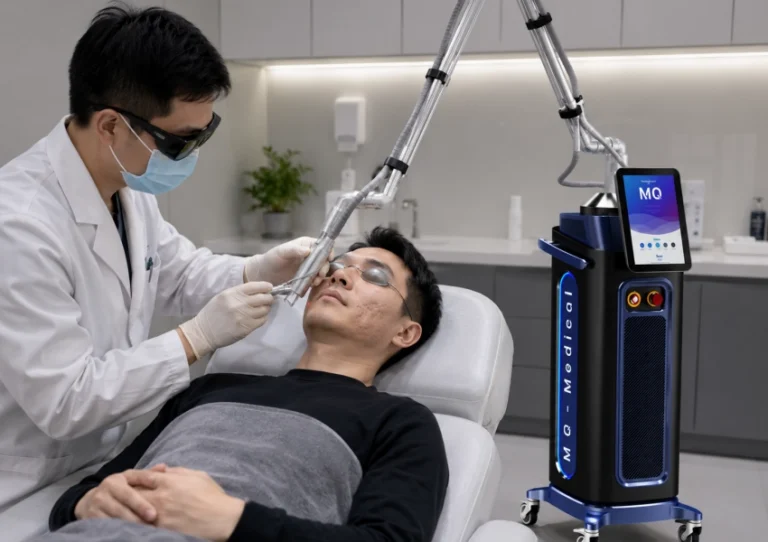
Beyond laser hair removal, AlexPlus offers a versatile range of aesthetic and dermatological applications through its 755nm Alexandrite and 1064nm long-pulsed Nd laser technologies. Its treatment capabilities include hair removal, diffuse redness reduction, vascular lesion treatments, facial treatments, and nail treatments. The system can target unwanted hair, visible facial vessels, and selected pigmentation concerns, while also supporting skin rejuvenation procedures and laser-based nail treatments. With multiple applications available in one platform, AlexPlus provides aesthetic clinics and dermatology practices with greater flexibility to address different patient needs and expand their treatment offerings.
What Ownership Looks Like After the Demonstration
Soprano Titanium may suit high-volume clinics already organized around in-motion diode training. AlexPlus may attract teams wanting separately selected Alexandrite and Nd:YAG channels and authorized additional indications. Existing staff skills influence the training burden. A claim of suitability for every patient is not credible for either device.
For Soprano, verify whether the offered version includes Trio, Quattro, or another applicator and which modes and cooling arrangement apply. For AlexPlus, identify pulse and spot ranges, cooling, and included accessories. Both quotes need maintenance, consumables, calibration, training, warranty, and local documents. The AlexPlus technical information and MQLASER supplier team can support product-specific questions.
Compare like-for-like packages across the diode laser equipment market. A trial with an upgraded applicator or different software is not equivalent to a base-model order.
| Clinic profile | Likely platform fit | Validation before purchase |
| High-volume hair-removal chain | Soprano Titanium-style in-motion diode workflow | Coverage consistency, room time, protocol reproducibility |
| Mixed skin and hair profiles | Either, depending on channel control and staff skill | Wavelength-specific output, skin-type guidance, test-spot pathway |
| Hair plus selected vascular/pigment services | AlexPlus may be relevant where indications are authorized. | Local clearance, accessory needs, training, and patient selection |
| Distributor / private-label route | Compare supplier configuration and service infrastructure. | Certification scope, spare parts, training, sample-to-bulk consistency |
The less visible cost is training and consistent recordkeeping. Can a supervisor tell whether staff used the right technique for each area? An ordinary clinic day exposes those issues more clearly than a polished demonstration built around maximum treatment speed.
Records should include phototype, hair caliber, treatment area, channel, spot, pulse, fluence, cooling, immediate reaction, operator, and follow-up. They may reveal technique inconsistencies or patient response patterns. Such records help internal quality control, although they are not a substitute for clinical evidence.
For clinics focused on large areas, the rhythm of diode in-motion treatment may be attractive. Others may use separate Alexandrite and Nd:YAG channels more effectively. Compare complete appointments, then evaluate training, service, consumables, and downtime against expected bookings. A three-versus-two wavelength argument cannot settle that choice. For more detail, see our guide on this article.
FAQ
Q1: Does Soprano Titanium’s triple-wavelength system suit every skin type?
A1: No. Approved indications, recent tanning, clinical assessment, settings, and cooling still matter.
Q2: Is AlexPlus another diode platform?
A2: No. The supplied AlexPlus specification describes Alexandrite and long-pulsed Nd:YAG solid-state channels.
Q3: Which machine is faster for a full-leg appointment?
A3: It depends on the applicator, technique, cooling pauses, and coverage. Compare complete appointments and follow-up.