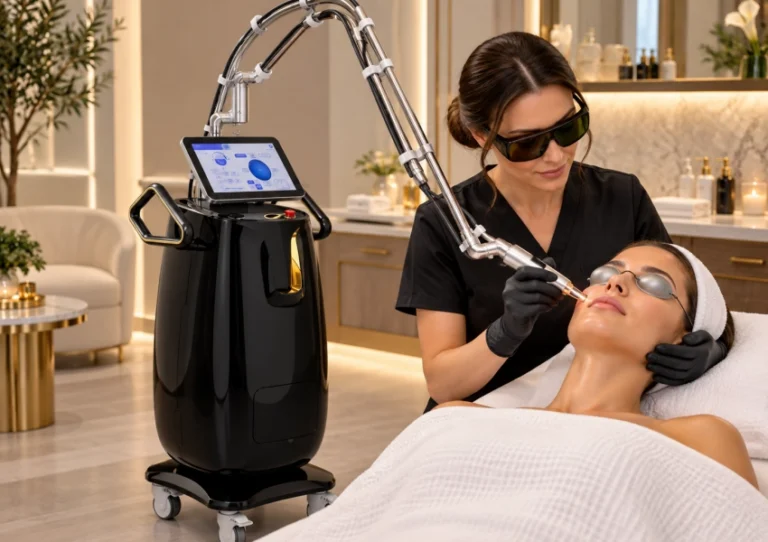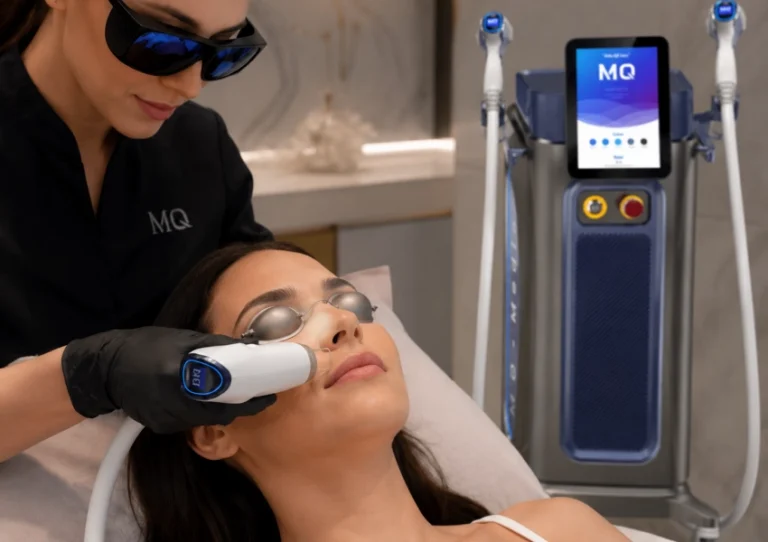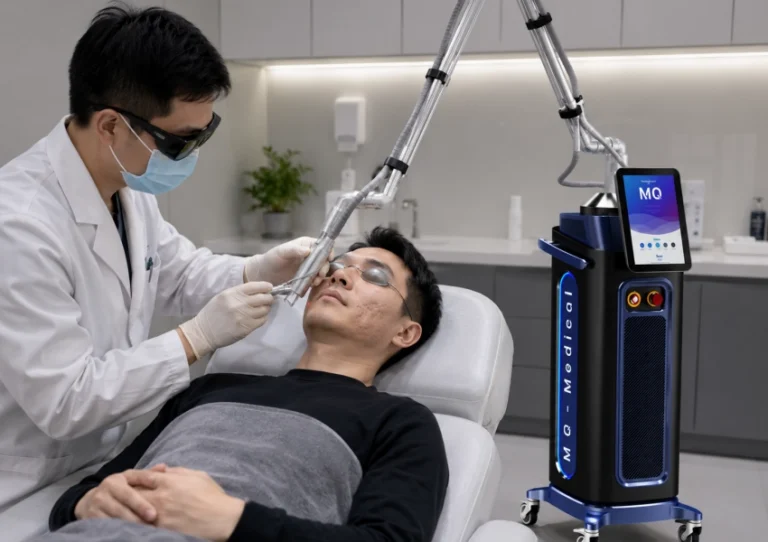
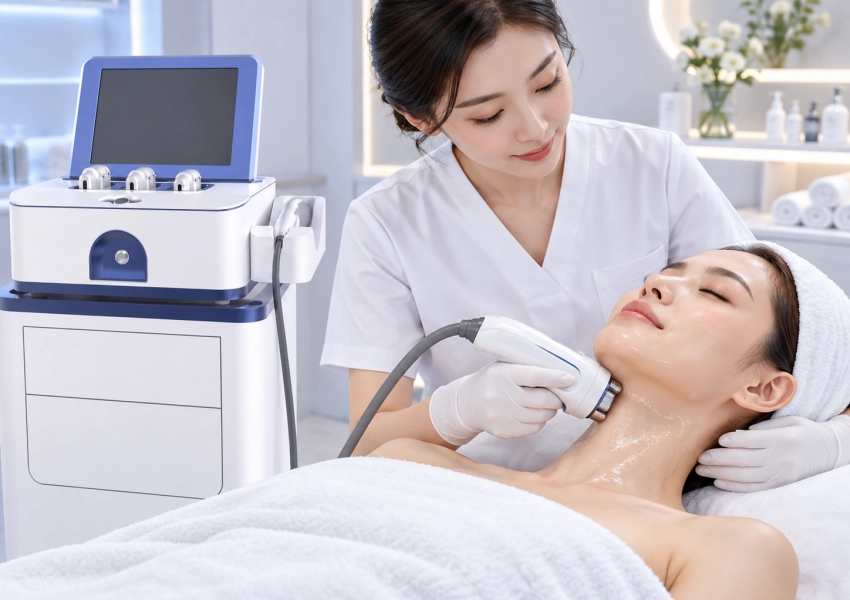
A face-and-neck HIFU service is not just a jawline treatment extended downward. The neck has thinner skin in some zones, different tissue thickness, visible structures, and anatomy that changes from the submental area to the anterior and lateral neck. A credible HIFU neck tightening program begins with patient selection and mapping, then chooses cartridge depth and line placement for each region. The treatment should be performed only by appropriately trained professionals within local scope and device authorization.
Focused ultrasound creates thermal coagulation points around 65–70°C at selected focal depths, followed by a wound-healing and collagen-remodeling response. It notes that improvement develops over roughly 3–6 months and may last 12–18 months, with substantial variation by patient, device, settings, and treatment area. Immediate tightening should not be presented as the final result.
Define the Clinical Target Before Selecting Cartridges
Separate skin laxity from submental fat, platysmal banding, loss of jaw support, and volume deficiency. HIFU may be considered for selected mild-to-moderate laxity, but it will not correct every neck contour concern. A patient with very thin tissue, prominent bony anatomy, substantial laxity, or low facial volume may need a different plan. Record baseline front, oblique, and profile photographs with consistent lighting and document the specific concern the patient wants addressed.
Common facial depths at 1.5 mm, 3.0 mm, and 4.5 mm, with 4.5 mm generally associated with deeper structural targets such as the SMAS-related plane. Those numbers are not interchangeable across cartridges or devices. Confirm focal length, frequency, energy range, line spacing, shot count, and manufacturer instructions for the actual device. The neck should not automatically receive the same cartridge or density as the cheek.
Screen Carefully and Map the Neck as Separate Zones
It calls for screening pregnancy, pacemakers or other implanted electronic devices, metal implants in or near the treatment field, active infection, active acne or inflammatory skin disease, and recent threads or fillers. Medication history and prior procedures should be reviewed under the clinic’s medical governance. The exact contraindications depend on the device instructions and local regulation, so the handbook’s list should guide a checklist rather than replace the manufacturer’s labeling.
Mark the submental, mandibular, anterior, and lateral neck as separate regions. Identify thyroid and laryngeal structures, prominent vessels, nerves, scars, and areas of altered sensation. Follow the device’s defined no-treatment zones and cartridge orientation. Do not stack high-energy lines over bony prominences or repeatedly fire in one small area. Maintain full coupling with ultrasound gel and steady, controlled contact; ask about sharp, radiating, or persistent pain and stop to reassess rather than treating through it.
Manage Comfort Without Losing Placement Accuracy
It has a typical 60–90 minute treatment and emphasizes adequate coupling gel, uniform movement, avoiding repeated high-energy passes, and reducing energy near sensitive anatomy. Comfort measures should follow the device instructions and clinic policy. A patient reporting unusual neuralgic pain, numbness, or marked focal tenderness needs immediate reassessment. The goal is controlled delivery at the intended plane, not the highest tolerable energy.
Track shots by region, cartridge replacement, treatment time, and follow-up completion. A quoted life of several thousand shots has limited value unless focal accuracy is maintained and replacement stock is available. Record discomfort by neck zone and delayed tenderness or sensory symptoms. Keep head position and camera distance consistent in follow-up photographs.
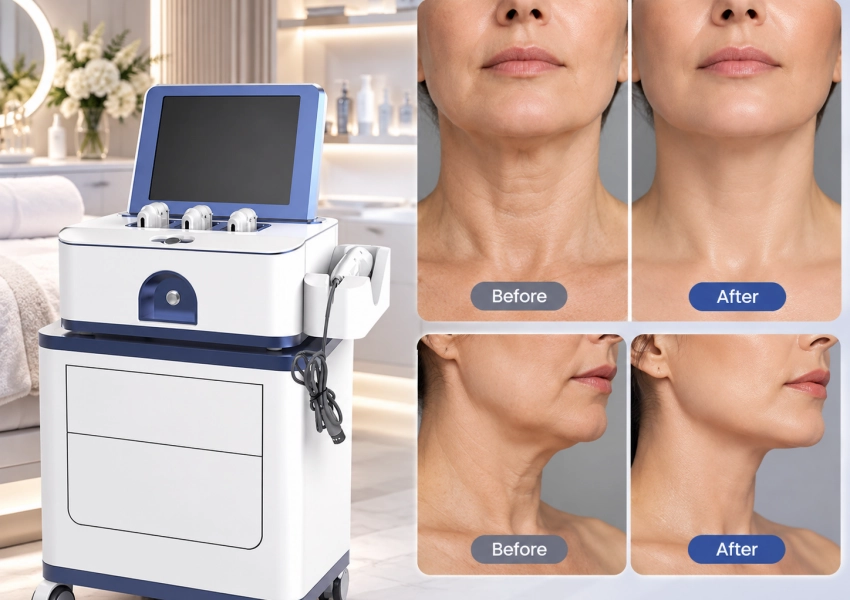
Set Expectations and Follow up on Responses Over Time
Explain that collagen remodeling is gradual. Visible evolution over 3–6 months and notes possible persistence up to 12–18 months; individual response varies. Mild tenderness, transient redness, swelling, or sensitivity may occur. Provide written aftercare, a contact pathway, and clear instructions for delayed pain, persistent sensory changes, burns, or other unexpected effects. Schedule review around one, three, and six months with comparable photographs, rather than selling automatic monthly retreatment.
If the patient is also considering fillers, threads, RF microneedling, or resurfacing, sequence treatments based on the target tissue, product labeling, and clinician judgment. It suggests spacing certain procedures, but combination timing should be verified for the specific treatment and local protocol. Avoid promises of a surgical-level lift or a fixed duration for every patient.
What to Verify in HIFU Equipment For an Aesthetics Clinic
A HIFU machine cartridge list is not enough. Ask for focal depth and distance, frequency, energy range, output consistency, shot counter, cartridge life, line spacing, contact quality, safety interlocks, and service calibration. It recommends requesting output test reports, clinical evidence, certification covering each cartridge, operator training, spare-cartridge availability, and written after-sales commitments. If the system offers imaging, verify whether it is real-time tissue visualization or only a user interface feature.
The MQLASER HIFU platform is listed with 1.5, 3.0, and 4.5 mm facial depth options and longer body cartridges. Confirm the exact delivered combination, energy range, cartridge shot life, and local documents before building the service menu. The HIFU equipment gives broader product context. A clinic should request protocol training for face and neck separately, not assume that a generic facial preset covers the neck.
For cartridge availability, training scope, and target-market documents, the clinic can contact the MQLASER team before finalizing the face-and-neck menu.
Track shots by region, cartridge replacement, treatment time, and follow-up completion. A quoted life of several thousand shots has limited value unless focal accuracy is maintained and replacement stock is available. Record patient discomfort by neck zone and any delayed tenderness or sensory symptoms. Keep the head position and camera distance consistent in follow-up photographs.
A strong face-and-neck program is built around anatomy, candidacy, documented delivery, and delayed follow-up. The device should support those steps. If a clinic cannot define target zones, no-treatment areas, cartridge logic, and review criteria, expanding the menu should wait until training and governance are in place.
The face-and-neck pathway should also state what happens when laxity is not the main problem. Patients with dominant submental fat, marked platysmal activity, severe laxity, or significant volume loss may need a different consultation. Recording the reason for treatment, selected depth, line count, pain response, and delayed findings helps the clinic compare outcomes by indication instead of treating every neck case as the same procedure.
The clinic can use the supplier’s HIFU equipment to confirm the current cartridge package, but the service protocol should be written locally after training. Ask for the target-market documents, cartridge replacement terms, and a named technical contact before the first patient is booked. A clear handover reduces the risk that staff improvise depth or line placement during a busy treatment day. If you would like to learn more, please read this article.
FAQ
Q1: Can a clinic use the 4.5 mm cartridge across the entire neck?
A1: No universal map applies. Cartridge use must follow device labeling, tissue assessment, anatomy, and trained clinical judgment.
Q2: When should patients expect HIFU results?
A2: It describes gradual change over about 3–6 months; response and duration vary by patient and protocol.
Q3: What evidence should a clinic request from a supplier?
A3: Verify market-specific certificates, cartridge coverage, output and focal-depth testing, clinical evidence, training, consumable life, and service terms.