Choosing the right laser hair removal machine involves more than just looking for high power. Choosing the right machine for your aesthetic clinic depends on whether the machine can fit into your treatment room as well as accommodate the volume of daily appointments and how the machine will fit into your team’s workflow as well as your client base. When choosing laser hair removal machines, the main criteria are wavelength coverage, energy density, repetition rate, cooling, shot lifespan, after-sales service, and certificates. All of these criteria are very important, not only in the beginning but also after months of daily use. That’s why you have to compare all the criteria of different machines on the market and not only the look of the machine on a website.
This article compares Deleo SUBLIM and MQLASER SUPLASER from a practical B2B buying angle. The goal is not to overstate one machine or dismiss the other. It is to show where each system may fit and why the technical differences matter for clinic owners, distributors, and beauty equipment buyers.
Why Portable Laser Hair Removal Machines Matter
Laser hair removal is a repeated-treatment service. Most clients do not finish the process in one visit, and clinics need equipment that can support steady use over multiple sessions. That makes stability, comfort, and service life important.
For smaller clinics, a desktop or portable system can save floor space. For busier centers, treatment speed and handpiece durability become more important. A device that looks affordable at first may cost more later if handpiece replacement, downtime, or service delays happen too often. That is why B2B buyers should avoid looking at only one figure, such as maximum energy.
Deleo SUBLIM: Compact Design for Standard Clinic Use
Deleo SUBLIM is positioned as a desktop laser hair removal machine. Its main selling point is its compact body and ergonomic handpiece design. According to the original comparison, Deleo places heavier laser components inside the main body, helping keep the handpiece lighter. For operators who perform several treatments in one day, this can make a real difference. Large areas such as legs, backs, and arms require steady hand movement. A lighter handpiece may reduce fatigue during repeated treatments, especially in clinics with limited staff.
In terms of parameters, SUBLIM uses a standard 785nm wavelength and offers an optional 1064nm wavelength. The machine also uses active air cooling to support skin surface comfort during treatment. Its maximum energy density is listed as 50J/cm², with a frequency range of 1 to 8Hz. The handpiece lifespan is listed at 10 million shots. For clinics with moderate daily demand, these specifications may be enough for regular hair removal services. SUBLIM is therefore more suitable for buyers who want a compact device for standard clinic use, especially when operator comfort is a priority.
MQLASER SUPLASER: Broader Wavelength Coverage and Longer Rated Lifespan
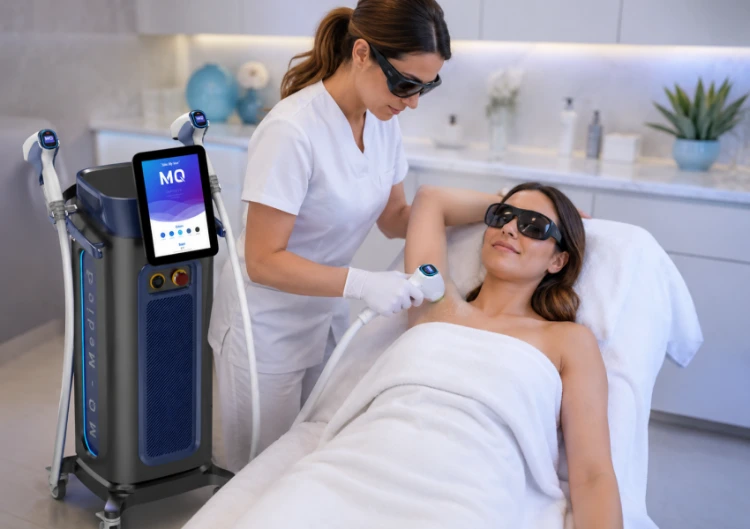
MQLASER SUPLASER is also designed for clinics that need a space-saving hair removal system, but its configuration is different. Its key advantage is the four-wavelength design. Instead of relying mainly on one wavelength with an optional add-on, SUPLASER integrates four wavelengths into one handpiece configuration.
This matters because clinics often serve clients with different hair thicknesses, skin tones, and treatment areas. A multi-wavelength system gives operators more choices when building treatment plans. It does not mean every case is simple, but it does give clinics more flexibility than a limited-wavelength setup.
SUPLASER also offers a maximum energy density of 70J/cm². Compared with the 50J/cm² of SUBLIM, this gives more parameter headroom. Higher energy does not automatically mean better results, and it should never replace skin assessment or proper cooling. Still, for trained operators, a wider energy range can be useful when treating more resistant hair types.
The frequency range of SUPLASER is 1 to 10 Hz. A higher maximum frequency may help shorten large-area treatments when the operator uses the correct technique and settings. In a busy clinic, even small workflow improvements can matter, but treatment speed should always stay within safe protocol limits.
The biggest commercial difference is the rated shot lifespan. SUBLIM is listed at 10 million shots, while SUPLASER is listed at 100 million shots. For high-volume clinics, this may reduce the frequency of handpiece replacement. Actual service life still depends on maintenance, cooling performance, cleaning, and usage intensity, but the difference is worth noting for long-term cost planning.
Side-by-Side Comparison
| Feature | SUBLIM® | SUPLASER |
|---|---|---|
| Speed | 1–8 Hz (up to 8 shots per second). Supports automatic emission, enabling very fast operation. | 1–10 Hz |
| Lifespan | Guaranteed over 10 million shots, helping reduce cost per session over time. | Up to 100 million shots, designed for long-term, high-volume use |
| Energy Density | Up to 50 J/cm², sufficient for dense and coarse hair types. | Up to 70 J/cm² |
| User Interface | Highly simplified and intuitive. The operator selects skin type and hair thickness, and the system automatically matches parameters. | Dual-mode interface with Guided Mode and Expert Mode, friendly for both beginners and experienced users |
| Distributor Requirements | No customization available. Premium pricing structure. | Supports multiple customization options with strong flexibility and high ROI |
| Wavelength Options | Limited to 785 nm and optional 1064 nm | Four selectable wavelengths: 755 nm, 808 nm, 940 nm, 1064 nm |
What These Differences Mean in Practice
For a small clinic with stable but moderate demand, Deleo SUBLIM can be a practical choice. Its desktop format and lighter handpiece may support comfortable daily operation. If the clinic mainly treats common hair removal cases and does not need wide customization, the system may cover the basic business need.
For clinics with more varied clients or higher daily treatment volume, SUPLASER has stronger commercial advantages. The four-wavelength configuration helps clinics handle more treatment scenarios. The 70J/cm² maximum energy density and 1–10 Hz frequency range give operators more room to adjust settings. The 100-million-shot-rated lifespan is also important for buyers who care about long-term operating cost. Still, buyers should not treat any specification as a guarantee. Laser hair removal depends on client assessment, correct parameters, treatment interval, and aftercare. A better machine can support better workflow, but professional operation remains essential.
| Aspect | Deleo SUBLIM® | SUPLASER |
|---|---|---|
| Customization | Fixed configuration, no customization | Extensive customization: software, appearance, parameters |
| Cost Efficiency | Higher upfront cost, premium pricing | Competitive pricing with strong ROI |
| Joint New-Tech Development | Closed product roadmap | Supports co-development and iterative upgrades |
| Market Flexibility | Best suited for standardized clinic workflows | Adapts to multiple regions and business models |
| Long-Term Scalability | Stable but limited expansion paths | Designed for growth and brand extension |
MQLASER Support for B2B Buyers
For distributors and clinic chains, supplier support can be as important as the device itself. MQLASER supports OEM/ODM projects, including logo design, appearance adjustment, software interface customization, language settings, and selected technical configurations. The available scope should be confirmed by model and order requirements. MQLASER also states that it invests 15% of annual turnover into product research and development. For buyers planning long-term cooperation, this can be useful because product updates and technical support matter after the first order.
As an international buyer, you should check before buying any product for possible use the corresponding certificates and registration of the product. These can be CE and ISO in general, but also RoHS certificates and other certificates for compliance with special requirements. The importer must note that one certificate is not valid in all countries, and the importer has to check the special local requirements for his products before buying. Also find out about after-sales support. Check the warranty, availability of spare parts, information material, remote service support, and the troubleshooting procedure as well as the response time of service personnel before ordering.
Conclusion
Deleo SUBLIM and MQLASER SUPLASER both serve clinics looking for compact laser hair removal equipment, but they suit different buyer needs. Deleo SUBLIM is better matched to standard daily treatments where compact design and handpiece comfort matter. MQLASER SUPLASER offers stronger advantages in wavelength coverage, rated shot lifespan, energy range, and customization support.
For clinics with higher treatment volume or more diverse client profiles, SUPLASER may provide more room for long-term business growth. For buyers comparing both machines, the final decision should include not only specifications but also service support, training, maintenance, certification requirements, and expected daily workload.
FAQ
Q1: What should clinics compare before buying a laser hair removal machine?
A1: Clinics should compare wavelengths, energy density, frequency, cooling system, handpiece lifespan, warranty, training support, and certification documents. These factors affect both treatment planning and long-term operating cost.
Q2: Does higher energy density always mean better results?
A2: No. Higher energy density gives more flexibility, but results also depend on skin type, hair thickness, pulse settings, cooling, and operator skill. Safe parameter selection is more important than simply using higher power.
Q3: Can SUPLASER be customized for distributors?
A3: Yes. MQLASER supports OEM/ODM customization for eligible projects, including logo, appearance, software interface, language settings, and selected technical configurations.