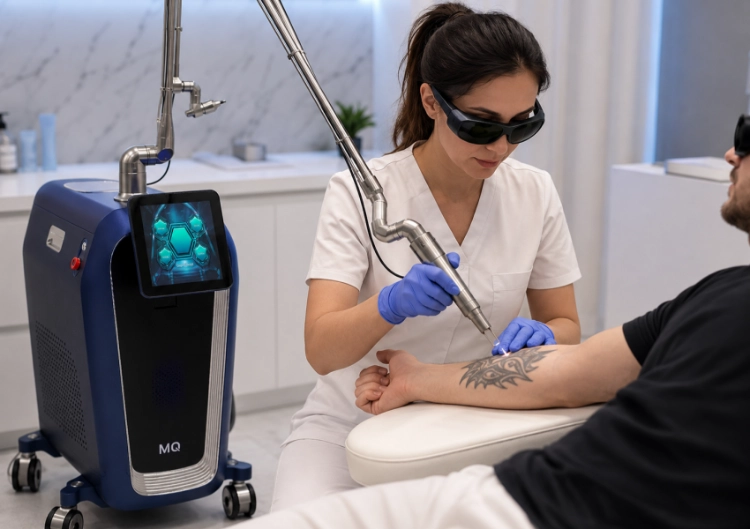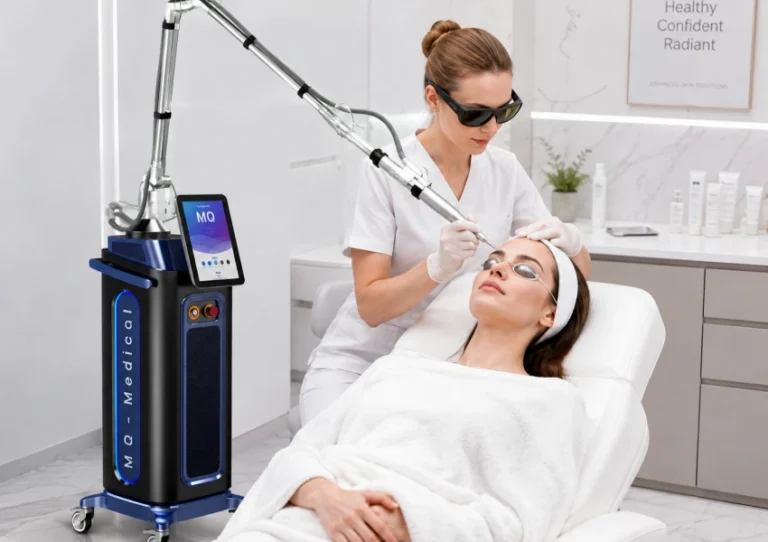
High-volume hair removal changes the buying question. The machine has to cover different body areas, keep the handpiece usable through a full schedule, and give operators a repeatable way to move between large and small zones. Alma Soprano Titanium and MQLASER SPLASER both answer that need with multiwavelength diode platforms, but their published configurations are not identical. A useful comparison starts with the delivered applicator, cooling system, operating mode, and ownership terms rather than the word “multiwavelength” alone.
Compare The Published Platform Configuration
Alma has three simultaneous wavelengths, a 4 cm² applicator, continuous contact cooling, SHR modes, and six available applicators. MQLASER has a four-wavelength SPLASER configuration, one applicator with seven changeable spot sizes, pulse and slide modes, and real-time temperature monitoring. The model and package should be confirmed before a purchase order is issued.
| Buying Point | Soprano Titanium | SPLASER |
| Wavelengths | 755 nm, 810 nm, and 1064 nm emitted simultaneously in the cited applicator. | 755 nm, 808 nm, 940 nm, and 1064 nm listed for the four-wavelength configuration. |
| Large-area coverage | Trio 4 cm² and Trio MAX 4 cm² applicators; Trio MAX includes a stated up-to-20% speed boost under stated conditions. | Spot options include 12*12 mm, 12*20 mm, 12*28 mm, 12*34 mm, 4*4 mm, Φ8 mm, Φ 10 mm. |
| Cooling | ICE Plus sapphire contact cooling is described as continuous; surface cooling is built into applicators. | Real-time cooling monitors applicator temperature 1,000 times per second. |
| Operating modes | SHR In-Motion, SHR Stack, and HR classic are listed. | PULSE and SLIDE modes; pulse duration is 5-170ms and repetition is up to 10 Hz. |
| Output expression | Applicators and speed; exact local energy limits require confirmation. | 1-200 J/cm² fluence and up to 2,400W peak power for the cited configuration. |
Why Applicator Size Changes Throughput
A 4 cm² contact applicator can reduce passes on a back or leg, while SPLASER’s 12x34mm rectangular option covers a different footprint. Area alone does not predict speed. Operator overlap, gel or skin preparation, hand repositioning, cooling pauses, and the time needed to change a tip all count. During a demonstration, record laser-on time and full room time separately. A five-minute claim is less useful than a repeatable appointment slot that includes setup and reset.
Read Cooling As An Operating Feature
Soprano Titanium uses sapphire contact cooling with SHR delivery, while SPLASER emphasizes real-time applicator temperature monitoring. These are different descriptions, not interchangeable proof of performance. Ask whether the system displays a live value, stops firing when a threshold is reached, and records faults. In a busy clinic, cooling stability affects comfort, operator confidence, and the number of unscheduled pauses during peak hours.
Match Wavelength And Mode To The Service Mix
Wavelength choice should follow the hair and skin mix in the booking system. 755n m as more strongly absorbed by melanin and useful for lighter skin and fine hair, 800-810 nm as a balanced general option, and 1064 nm as deeper-penetrating with lower epidermal melanin absorption. Those are selection principles, not a promise that one setting suits every client. A four-wavelength package only creates value when staff can choose it consistently.
Soprano Titanium For A Branded Workflow
Alma has a graphical interface with presets based on skin type, body size, and treatment area, as well as Smart Clinic reporting for utilization and ROI. That may suit a clinic with a defined branded workflow and a need to manage several operators. Confirm the local training route, data subscription or access terms, and which applications are included rather than assuming every regional package is the same.
SPLASER For Configuration And Service Breadth
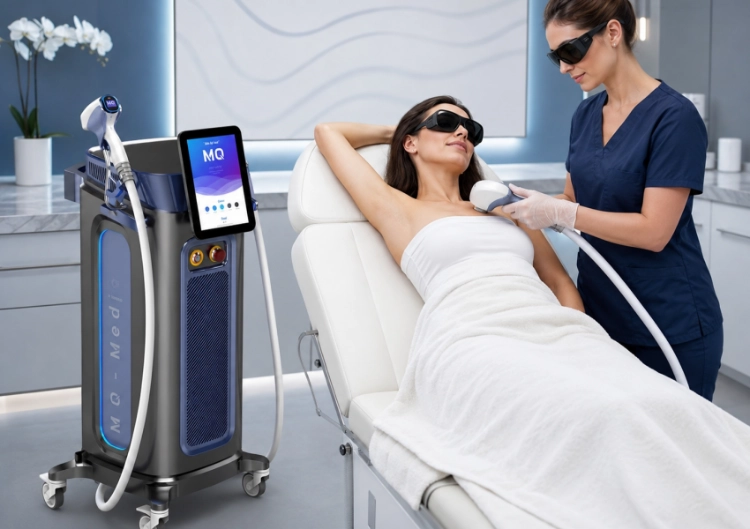
The SPLASER four-wavelength platform has a 2400W peak-power specification in the product material, a 1-200 J/cm² fluence range, up to 10 Hz repetition, and seven changeable spot sizes. The single lightweight applicator can reduce the need for multiple handpieces, but the buyer should confirm tip changeover time, replacement terms, and the exact 1200W or 2400W configuration offered. The diode laser hair removal equipment is useful for separating SPLASER from other diode configurations when a distributor is building a product line. The quotation should identify the exact model rather than rely on a category-level comparison.
Calculate High-Volume Ownership, Not Just Purchase Price
A premium platform may justify a higher entry price if its room utilization, training pathway, reporting, and local service are valuable. A configurable platform may create a better fit when the clinic needs four wavelengths, multiple tip sizes, and a lower-cost ownership plan. Build the comparison with monthly completed sessions, average room minutes, staff cost, financing, consumables, warranty exclusions, planned maintenance, and the cost of a replacement applicator. Do not use the highest possible booking count as the base case.
| Commercial Factor | Soprano Titanium | SPLASER | Decision Test |
| Customization | Confirm permitted branding, package, software, and local channel options. | MQLASER supports OEM/ODM discussion for eligible projects. | Request the proposed configuration in writing. |
| Consumables | Confirm applicator and accessory replacement pricing through the local channel. | Product material highlights no disposables for the hair-removal process and one applicator with changeable tips; confirm exclusions. | Price five years of tips, handpieces, and service parts. |
| Training | Preset-based interface and local training scope require confirmation. | Confirm installation, parameter training, refresher support, and translated materials. | Test whether a second operator can reproduce the approved workflow. |
| R&D cooperation | Future changes follow the brand and channel release path. | MQLASER reports an experienced R&D team and annual investment of 15% of revenue in new product development. | Ask what is standard, optional, or project-specific. |
| Market flexibility | Strong fit where a premium branded service is central. | Four-wavelength and OEM/ODM options may suit varied distributor or clinic segments. | Compare local selling price with support obligations. |
Use A Three-Shift Demonstration
Ask the supplier to run a large area, a small area, and a handover between operators. Record startup time, mode selection, tip or applicator change, cooling response, cleaning, and fault recovery. Then ask what happens if the handpiece needs service during a full week. MQLASER’s broader diode portfolio and project support can be useful for a growing clinic or distributor, but the purchase order should still name the model, tips, training, warranty, and response route. For a supplier-level review of project support and configuration scope, use the MQLASER as the company reference and keep all commercial commitments in the quotation. Should you have any questions, please contact us.
Conclusion
Soprano Titanium may fit a high-volume clinic that values a branded three-wavelength workflow, sapphire contact cooling, large applicators, and cloud-based utilization tools. SPLASER may fit a buyer seeking four listed wavelengths, seven spot-size options, real-time applicator monitoring, and room for OEM/ODM configuration. The final decision should come from a timed demonstration and a five-year cost model built around the clinic’s actual service mix. If you would like to learn more, please read this article.
FAQ
Q1: Is SPLASER a four-wavelength laser in every configuration?
A1: SPLASER has 755 nm, 808 nm, 940 nm, and 1064 nm. Confirm the wavelength set, power version, and included tips on the exact quotation.
Q2: Which platform is faster for a busy clinic?
A2: Speed depends on applicator footprint, mode, operator technique, cooling pauses, and room setup. Time a complete service workflow rather than relying on a headline speed claim.
Q3: What should be included in an SPLASER RFQ?
A3: Request wavelengths, peak power, fluence, pulse range, repetition rate, tip sizes, cooling behavior, training, warranty, replacement parts, and OEM/ODM scope.