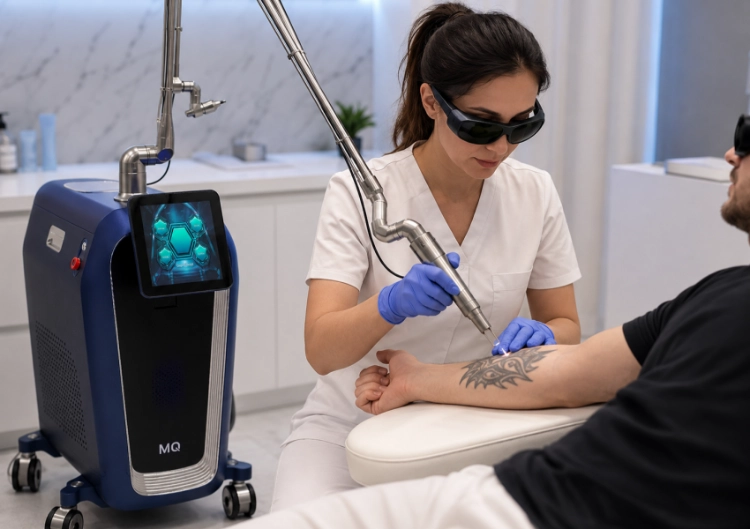
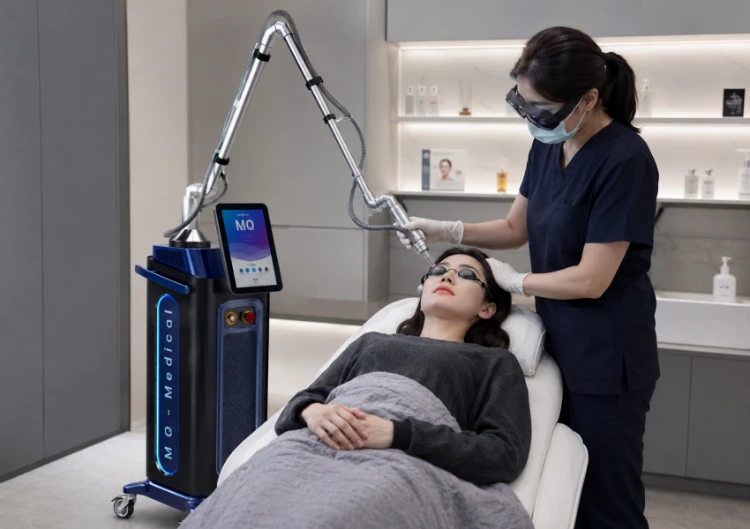
A service menu can look healthy on paper and still fail to repay a machine. The usual reason is not a poor headline price. It is a price built without the minutes between appointments, the real room cost, the operator’s paid time, and the maintenance reserve. A fractional CO₂ laser cost model should begin with capacity and contribution, then turn into a client-facing price that is consistent with the local market. For a beauty business, the goal is a sustainable service line, not the lowest number on a competitor’s booking page.
Start With a Price Floor, Not a Competitor’s Menu
A local CO₂ laser treatment price can vary sharply by city, service area, provider mix, included aftercare, and the level of consultation built into the booking. That makes published consumer prices a weak planning tool. Your price floor should come from internal figures that can be checked every month. The useful question is simple: what must one completed booking contribute after direct cost if the machine is to cover its share of the business?
Separate Fixed Cost From Per-Session Cost
Put the delivered machine cost, financing or capital charge, insurance, room rent allocation, annual service plan, routine maintenance reserve, staff training, and local marketing on the fixed-cost side. Then list items that rise with each booking: operator time, disposable supplies, cleaning, payment fees, any included consumable pack, and a practical allowance for follow-up communication. Do not push every cost into a vague overhead percentage. When costs are visible, a manager can see whether a discounted package still makes commercial sense.
Use Conservative Capacity in the First Model
A machine may be capable of delivering a short pass, but paid capacity includes check-in, room preparation, setting confirmation, service delivery, cleaning, notes, and a margin for a late arrival. Build the first forecast from completed paid bookings per week, not from the theoretical number of laser minutes in a day. A cautious model can later be revised upward. An ambitious model that misses its target usually leads to rushed staff and price pressure.
| Pricing input | How to calculate it | Why it changes the decision |
| Monthly fixed machine burden | Delivered machine cost or finance payment + planned maintenance reserve + room and insurance allocation | Shows the monthly contribution the service line must recover before profit. |
| Variable cost per completed service | Operator minutes + supplies + cleaning + payment fee + included aftercare items | Sets the minimum contribution required from each booking. |
| Conservative paid volume | Completed bookings per week x realistic operating weeks per month | Prevents a forecast based only on a fully booked calendar. |
| Required contribution per service | (Monthly fixed machine burden / conservative paid volume) + variable cost per service | Creates an internal price floor before local positioning and margin. |
| Target selling price | Required contribution + planned operating margin, checked against local service scope | Keeps discounting and package design under control. |
For example, do not call a service profitable merely because its selling price is above supplies. It also needs to carry a fair share of the machine and the room. This distinction matters most during launch months, when appointments may be lower than the intended steady-state volume.
Build Service Tiers Around Room Time and Scope
A single flat fee makes administration easy, but it can hide the difference between a compact-area booking and a larger-area booking that occupies the room much longer. A more defensible CO₂ laser business model groups services by time block, service area, operating mode, and the preparation or aftercare workload included in the booked scope. The team should be able to explain the difference in plain terms without promising a fixed cosmetic outcome.

Price the Appointment Block Rather Than the Pulse
Set an internal time allowance for small, medium, and extended service blocks. Each block should include preparation and room reset, not just device-on time. If a medium block requires twice the room time of a small one but is priced only slightly higher, it may take the most profitable hours away from simpler bookings. A short measurement period can reveal whether the menu needs three blocks or only two. Keep the client-facing menu clear; keep the detailed cost logic in the management file.
Package Only When Capacity Still Works
Packages can improve forward bookings, yet the unit price should not be reduced before checking the contribution across the whole package. Count the expected staff minutes, no-show policy, included support, and likely calendar spacing. A package is useful when it makes demand more predictable without filling peak slots with low-contribution work. For a new fractional CO₂ laser machine, it is often wiser to test a limited launch allocation than to make a permanent discount the business later struggles to remove.
Clinical Service Mapping Before Pricing
A fractional CO₂ appointment should be priced around the complete service pathway, not only the time when the laser is emitting energy. The booking begins with a consultation, service-area selection, client photographs, preparation, parameter confirmation, treatment delivery, cooling or comfort support, cleaning, documentation, and aftercare communication.
Before the appointment, the operator should record the main service area, the planned coverage, the selected fractional or cutting mode, the expected number of passes, and the client’s available recovery window. A small facial area, a full-face service, and a localized texture program should not occupy the same room-time block. Each may require different marking, handpiece movement, scan density, and post-service instructions.
During the service, the area should be divided into manageable zones. The operator can document the selected duration, point distance, interval, repeat count, and scan pattern for each zone. DEPPLUS lists duration from 0.1 to 9.9 ms, point distance from 0.1 to 2.0 mm, interval from 0.1 to 2 seconds, and repeat settings from 1 to 10. These values should be treated as documented operating variables rather than numbers to increase automatically. A higher repeat count or closer point distance may also change room time, comfort management, cleaning requirements, and the aftercare discussion.
Linking Client Communication With the Room Schedule
The service team should explain the expected recovery window in relation to the selected program, treatment area, and number of passes. A fixed recovery promise does not fit every fractional CO₂ booking. The client should leave with written aftercare instructions, the recorded program, the treated zones, and a clear contact route for questions after the appointment.
Follow-up communication also has a business value. A short message can confirm whether the client has followed the aftercare plan, whether the next appointment should be scheduled, and whether the original service block was long enough. When these records are reviewed monthly, the clinic can see which programs require additional preparation time or create longer room turnover.
This makes the price more defensible. The client is paying for a managed service process, while the clinic is recovering operator time, room occupancy, equipment use, cleaning, documentation, and follow-up work. A DEPPLUS configuration with 10,600 nm output, a 70 W RF-excited metal tube, approximately ±3% power-stability targeting, and a seven-joint articulated arm can support a repeatable workflow, but the financial result still depends on how consistently the team delivers that workflow.
For a U.S. clinic, the fractional CO₂ laser cost model should be built around contribution per session rather than the machine price alone. As an illustrative calculation, assume a clinic charges $1,500 for a fractional facial session. Deduct $150 for provider labor, $75 for room and administrative overhead, $60 for disposable supplies, $65 for payment and booking costs, and a $100 maintenance reserve. The estimated contribution is $1,050 per session. If the clinic invests $35,000 in the equipment, installation, and initial setup, the equipment-only break-even point is approximately 34 sessions ($35,000 ÷ $1,050). This is a planning example, not a DEPPLUS quotation. Actual pricing should be adjusted for state labor costs, facility expenses, financing, local service rates, treatment area, consumables, training, and the final machine configuration.
Use DEPPLUS Features to Protect Service Consistency
Price discipline depends on a system that can hold a repeatable workflow. DEPPLUS is specified at 10,600 nm with a 70 W RF-excited metal tube, a quoted power-stability target of about plus or minus 3 percent, and a seven-joint articulated arm for 360-degree access. Its listed scan choices include sequence, random, continuous, and UltraPulse patterns. These features do not set your local fee, but they give the operator a structured platform from which to build consistent room timing and protocol documentation.
Match Operating Modes to the Booked Scope
DEPPLUS has SuperPulse, UltraPulse, and continuous-wave modes, along with fractional and cutting working modes. A beauty business should define which approved operating paths belong to each booked service, the expected room time, and the required handover note. The point is not to use every mode in a sales conversation. It is to prevent a service from drifting beyond its planned time because settings, scan pattern, or preparation were never standardized.
Treat Equipment Stability as a Revenue Variable
If a machine needs an unplanned service visit during a fully booked week, the cost is more than a repair invoice. It may include cancellations, staff idle time, rearranged rooms, refunded deposits, and confidence lost by the front desk. The RF-excited metal-tube approach described in the metal RF tube guide is relevant here because tube choice affects the maintenance conversation. Ask for the written warranty, rated service conditions, maintenance schedule, spare-part route, and any exclusions before using a five-year ROI model.
Track ROI With a Five-Year Operating View
Med spa laser ROI is easier to manage when it is reviewed as a monthly operating figure and a five-year ownership figure. The monthly view tells you whether the current booking mix is carrying its cost. The longer view tests whether a lower purchase quote really remains lower after servicing, expected repairs, training refreshers, and downtime risk. Neither view should rely on a supplier’s generic payback claim.
| Five-year ROI checkpoint | What to record | Management action |
| Utilisation | Available service blocks, completed paid blocks, cancellations, and no-shows by month | Change opening hours, deposits, or promotion timing before discounting every service. |
| Revenue quality | Average realised price after packages, refunds, and promotions | Check whether the advertised price and collected price are drifting apart. |
| Direct cost | Operator minutes, supplies, payment fees, and included support per service type | Remove unplanned inclusions or reprice the service block when contribution falls. |
| Equipment reliability | Planned checks, alarms, lost room hours, repairs, and parts used | Compare maintenance reserve with actual cost and protect peak-season capacity. |
| Capital recovery | Cumulative contribution against delivered machine, training, installation, and financing cost | Use the gap to decide whether volume, price, service mix, or promotion needs adjustment. |
The fractional CO₂ laser machine can help a buyer compare the platform family before a quote is finalised. Request a configuration that names the tube type, power option, mode set, arm, training, warranty, and spare parts. MQLASER also supports OEM and ODM discussions, and its product development programme is supported by an experienced R&D team with 15 percent of annual turnover directed to new products. For distributors, that can matter when screen language, packaging, branding, or service documentation need to fit a local channel.
Conclusion
There is no universal fractional CO₂ laser cost or treatment price that produces ROI in every market. A sound price starts with a fixed machine burden, variable service cost, conservative paid volume, and a reasonable contribution target. Then it is tested against room time, service consistency, and maintenance exposure. A DEPPLUS configuration can support that process when the order includes the right mode package, training, warranty, and service terms. For a project-specific configuration and support scope, MQLASER should provide the details in writing before the financial model is approved. Continue reading our other guide.
FAQ
Q1: Should a business copy a competitor’s CO₂ laser treatment price?
A1: No. Use competitor prices only as local context. Build your own floor from fixed costs, direct service costs, realistic completed volume, and room time.
Q2: What should a five-year laser machine ROI model include?
A2: Include delivered equipment, installation, training, maintenance, parts, downtime, room allocation, staff time, payments, promotions, and realized service revenue.
Q3: Can MQLASER support a distributor-specific DEPPLUS package?
A3: MQLASER supports OEM and ODM discussions. Confirm the selected power, operating modes, branding, documentation, training, warranty, spare parts, and destination-market requirements in the quotation.