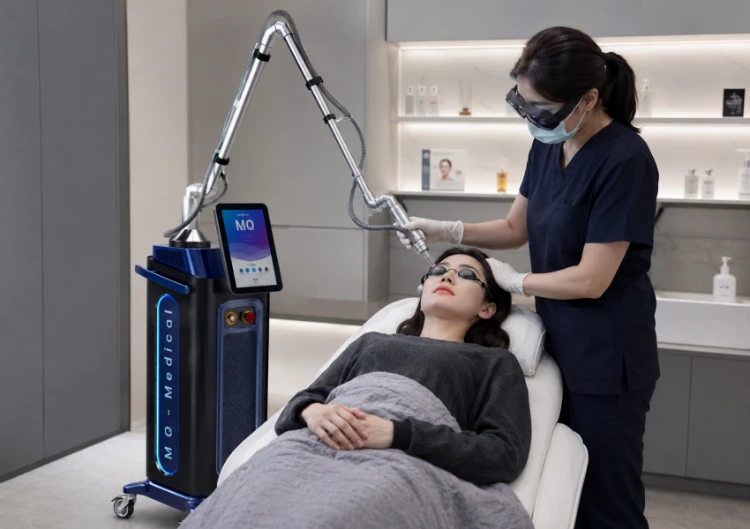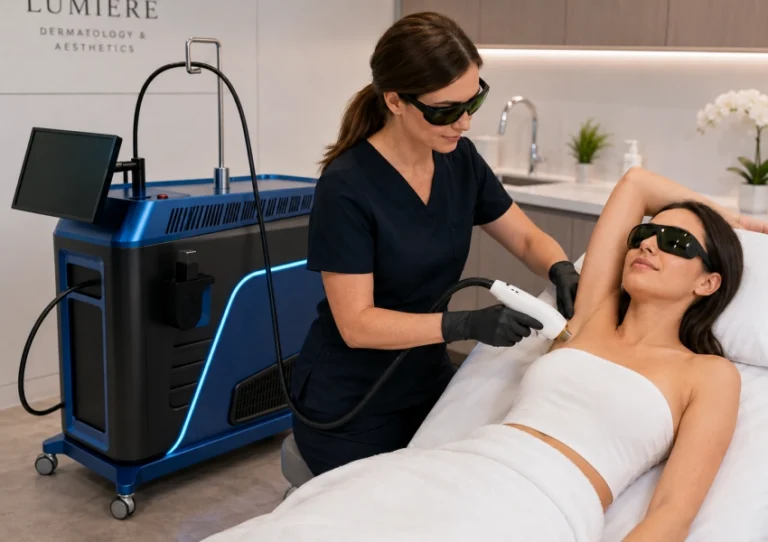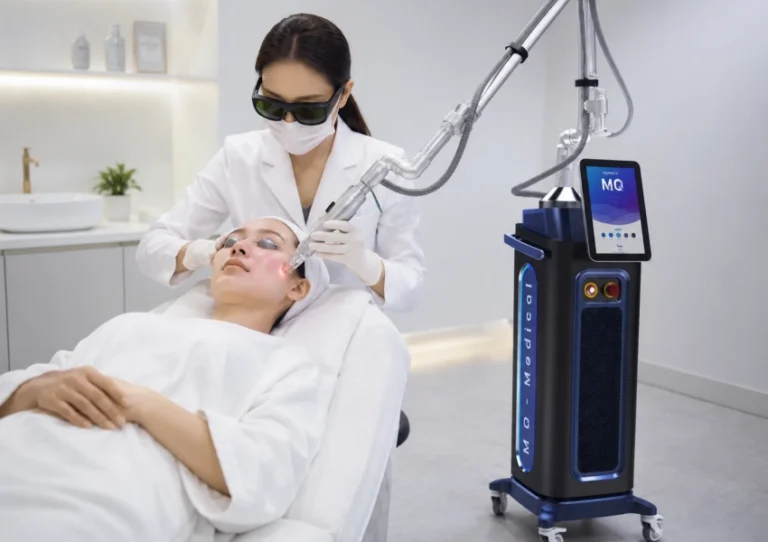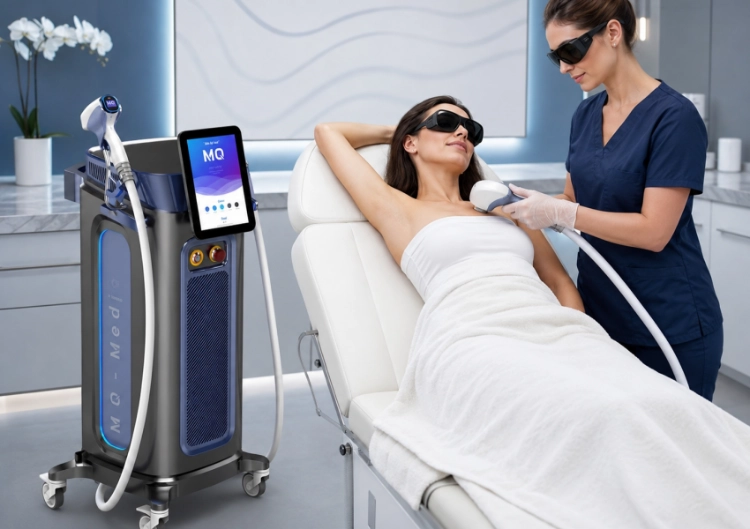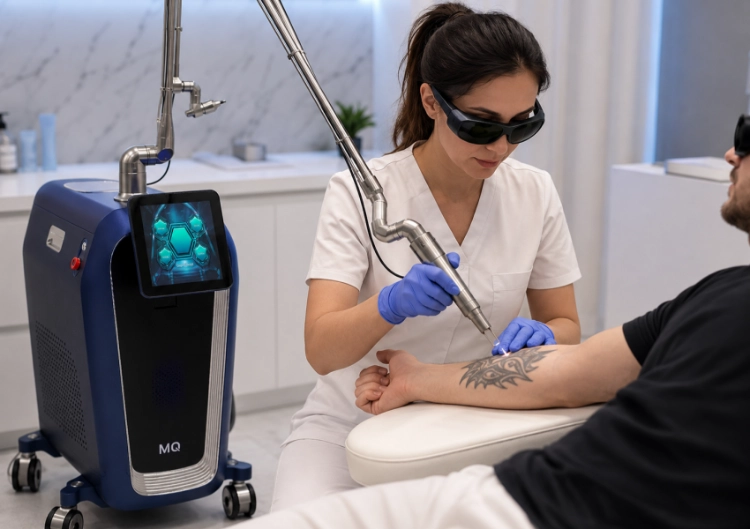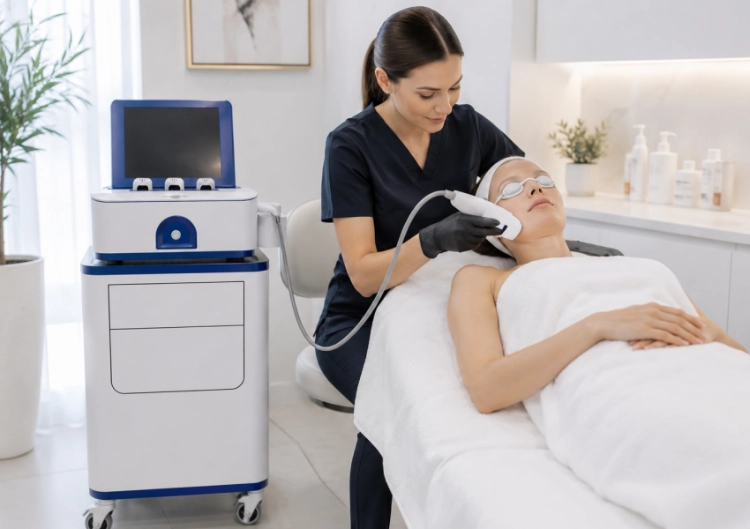
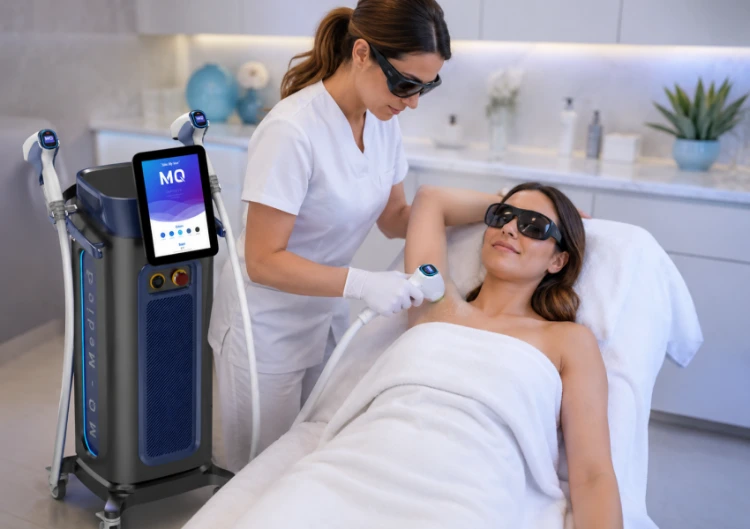
Throughput is not a claim about one short session. It is the number of appointments a hair-removal room can complete across a real week, including preparation, parameter selection, cleaning, operator handover, and unscheduled downtime. That is why LightSheer QUATTRO and SPLASER should be compared through the whole shift. Both are diode laser hair removal platforms, but they use different approaches to body-area coverage, cooling, handpiece workflow, and operating flexibility.
Throughput Begins With the Service Route
A high-volume laser clinic needs a repeatable path from client check-in to room reset. The operator confirms the service area and protocol, prepares the contact surface, selects the handpiece or tip, delivers the planned pass, cleans the applicator, records settings, and prepares the next appointment. The machine matters because it either shortens these transitions or adds friction at every stage.
Quattro Uses Area-Specific Handpieces
LightSheer QUATTRO has 805 nm and 1060 nm diode routes, plus a 22 x 35 mm HS vacuum-assisted handpiece, 12 x 12 mm XC handpiece, and 9 x 9 mm ET handpiece. It also has vacuum assistance for larger areas and ChillTip sapphire contact cooling for finer or higher-density work. Exact availability, power, pulse range, included handpieces, temperature performance, and local regulatory status should be confirmed for the current regional version.
SPLASER Uses a Configurable Diode Platform
The SPLASER diode platform lists an 808 nm operating center, with 755 nm, 940 nm, and 1064 nm available as custom wavelengths. It has 2,400 W maximum peak power, 1-200J/cm² fluence, up to 10 Hz repetition, and 5-170 ms pulse duration. It also has seven changeable tips, including 12 x 12 mm, 12 x 20 mm, 12 x 28 mm, 12 x 34 mm, 4 x 4 mm, 8 mm, and 10 mm options. The ordered configuration needs to state which tips and wavelengths are supplied.
A Full-Body Appointment Has Several Operating Stages
A high-volume hair-removal appointment should be divided into assessment, preparation, treatment, verification, and room turnover. The operator first confirms the body area, hair density, previous service history, selected wavelength, and the handpiece or tip required for the session. This short review reduces the risk of carrying settings from a previous client into a different service area.
Large areas such as the back, legs, and arms require a consistent zone map. The operator should work through the map in a fixed direction, keep contact even, and avoid unnecessary repeated passes. LightSheer QUATTRO offers a 22 x 35 mm HS vacuum-assisted handpiece for larger areas, while SPLASER lists rectangular tips up to 12 x 34 mm. The comparison should include the actual number of placements, hand movement, vacuum or contact checks, and the time required to change from one zone to the next.
Small contours create a different workflow. QUATTRO lists 12 x 12 mm XC and 9 x 9 mm ET handpieces. SPLASER lists 4 x 4 mm, 8 mm, and 10 mm options alongside larger rectangular tips. These smaller options may help the operator work around facial contours or other limited areas, but each additional handpiece or tip also introduces a cleaning, storage, selection, and handover step.
Cooling and Client Comfort During Consecutive Services
Cooling should be checked before the first pulse and observed throughout the appointment. For QUATTRO, the demonstration should include vacuum preparation for the HS handpiece and ChillTip sapphire contact cooling for the XC or ET route. For SPLASER, the team should observe the real-time applicator temperature display, tip contact, and the response of the cooling system during PULSE or SLIDE operation.
The operator should pause when contact becomes uneven, cooling feedback rises unexpectedly, the client reports excessive heat, or the applicator does not recover as expected between zones. The event should be recorded with the treatment area, handpiece or tip, wavelength, fluence, pulse duration, repetition rate, and cooling status. This record helps separate a workflow issue from a maintenance issue.
A useful clinic demonstration should include three appointments: a large leg or back session, a smaller contour session, and a mixed schedule that changes tip or handpiece type. Record preparation time, treatment time, cleaning, cooling checks, setting documentation, and room reset. Throughput is the number of complete service cycles the team can repeat, not the laser-on time shown during a short demonstration.
Compare Handpieces, Cooling, and Daylong Operation
A large treatment window can reduce placements across a back or legs, but that advantage disappears if preparation or recovery slows the next booking. A smaller tip can be practical around contours, yet it should not create a cumbersome handpiece change routine. Cooling is also part of throughput because discomfort, inconsistent contact, and overheating can interrupt a full schedule.
| Public performance and workflow point | LightSheer QUATTRO | MQLASER SPLASER |
| Wavelength approach | 805 nm and 1060 nm diode routes. | 808 nm operating center; 755 nm, 940 nm, and 1064 nm listed as custom options. |
| Large-area coverage | HS 22 x 35 mm vacuum-assisted handpiece is described for large areas. | Changeable tips include 12 x 34 mm and 12 x 28 mm; tip selection is part of the ordered package. |
| Small-area work | XC 12 x 12 mm and ET 9 x 9 mm handpieces. | 4 x 4 mm, 8 mm, and 10 mm options are listed alongside rectangular tips. |
| Energy and pulse expression | Exact power, fluence, pulse-width, and repetition-rate figures need current official regional confirmation. | Published: 2,400 W peak power, 1-200J/cm² fluence, up to 10 Hz, 5-170 ms pulse duration. |
| Cooling and contact | Vacuum assistance is described for HS; ChillTip sapphire contact cooling is described for XC/ET. | Real-time cooling monitors applicator temperature 1,000 times per second; confirm the cooling configuration and service process in the quote. |
| Daily operating tools | Confirm displays, stored protocols, handpiece change steps, and service diagnostics by software version. | PULSE and SLIDE modes plus IoT usage/performance monitoring are listed; confirm regional software and connectivity scope. |
For a high-volume hair-removal clinic, the difference is not simply two wavelengths versus several options. QUATTRO can fit a clinic that values dedicated area-specific handpieces and vacuum-assisted large-area work. SPLASER can fit a buyer that wants a flexible tip set, an optional wavelength package, and real-time temperature monitoring. A timed demonstration with a back, leg, and small-contour sequence gives a better answer than a brochure headline.
Design the Shift for Multiple Operators
The system must keep its rhythm when more than one operator uses it. A strong handover record avoids repeated consultation, inconsistent settings, and unnecessary pauses. Set a standard log for the client area, selected tip or handpiece, wavelength configuration, pulse mode, fluence, duration, repetition, contact-window condition, and cooling status. This is particularly important at peak hours, when staff may alternate rooms.
Measure the Minutes Between Appointments
During a demonstration, time the full cycle: preparation, handpiece or tip selection, service delivery, cleaning, parameter recording, and room reset. For the QUATTRO route, include vacuum and contact-cooling checks. For SPLASER, include tip changes, the real-time cooling status, and whether PULSE or SLIDE mode suits the planned service. If the calendar is designed around only laser-on time, it will overstate capacity.
Plan for Maintenance Before Peak Season
A high-volume schedule needs preventive maintenance built into the calendar. Check ventilation, cooling medium or contact surface, applicator window, cable strain, filters, software alarms, and connector wear at agreed intervals. Ask both suppliers for the expected duty cycle, normal temperature range, replacement-handpiece lead time, calibration plan, spare-part stocking, and maximum response time. These are throughput controls because a stopped room has a direct revenue cost.
Compare Five-Year Cost at the Configuration Level
The five-year cost is not the sticker price multiplied by five. Build a model that includes delivered equipment cost, installation, operator training, handpiece or tip service, cooling or contact-system maintenance, calibration, preventive checks, replacement parts, room downtime, and financing. Then divide that total by a conservative number of completed paid services. Keep regional labor, rent, energy, and selling price as local variables rather than copying a supplier’s payback claim.
| Procurement dimension | LightSheer QUATTRO route | MQLASER SPLASER route |
| Customization | Confirm what the regional product package allows for handpieces, software, and service agreement. | MQLASER supports OEM/ODM projects; the buyer can discuss branding, screen language, tip package, and optional wavelengths. |
| Cost and value | Value depends on regional machine price, vacuum and cooling system scope, handpiece package, and local service contract. | Value depends on selected wavelengths, tips, IoT scope, cooling configuration, training, and spare-parts package. |
| Collaborative R&D | Established platform route; confirm the local channel’s ability to support special needs. | MQLASER reports an experienced R&D team and annual R&D investment of 15% of turnover, relevant to distributor configuration projects. |
| Market flexibility | Useful where an established dedicated-handpiece workflow matches the clinic’s service menu. | Useful where the distributor needs a configurable diode package and differentiated local sales story. |
| After-sales and training | Confirm warranty, trainer availability, vacuum/cooling maintenance, parts stock, and response commitment. | Confirm CE/ISO/RoHS document scope, training, real-time cooling maintenance, warranty, spare parts, remote support, and response commitment. |
The MQLASER diode laser provides a useful comparison point for adjacent diode configurations. After the technical review, a buyer can discuss packaging, OEM/ODM scope, and project support through MQLASER and project support. The purchase order should still name all included tips, cooling items, accessories, training days, service response terms, and warranty exclusions.
Conclusion
LightSheer QUATTRO and SPLASER can both support a busy hair-removal operation, but their throughput case is built differently. QUATTRO is organised around dedicated handpieces, vacuum assistance, and contact cooling. SPLASER is organised around configurable wavelengths and tips, PULSE/SLIDE operation, IoT monitoring, and real-time cooling feedback. The better choice is the one that moves your actual appointment mix through the room with fewer resets, fewer service gaps, and a support agreement that matches peak-season demand. For more detail, see our guide on this article.
FAQ
Q1: Does a larger handpiece always mean higher throughput?
A1: Not by itself. Compare preparation, handpiece changes, cooling or vacuum checks, cleaning, documentation, and room reset. Total cycle time determines capacity.
Q2: What SPLASER figures are published?
A2: SPLASER has 2,400 W peak power, 1-200J/cm² fluence, up to 10 Hz repetition, 5-170 ms pulse duration, and configurable wavelengths and tips.
Q3: What should a five-year comparison include?
A3: Include purchase, installation, training, service, cooling or vacuum maintenance, calibration, spare parts, downtime, local labor, room costs, and conservative completed-service volume.