A clinic upgrade should start with the service it needs to deliver, not the logo on the console. Ultherapy PRIME and MQLASER HIFU are both focused-ultrasound platforms, but the buyer must compare target-layer planning, face and neck workflow, probes, training, replenishment, and service economics.
Start With Facial Layers And Clinical Function
It separates facial work into 1.5 mm for superficial epidermal and dermal layers, 3.0 mm for the deeper dermis and collagen-rich zone, and 4.5 mm for the SMAS layer associated with facial structural lifting. It lists 6.0-13.0 mm for body contouring. A clinic should specify its fine-line, dermal tightening, jawline, neck, or face-and-body menu before choosing probes.
What the 1.5, 3.0, and 4.5 mm Choices Mean
A 1.5 mm plan suits lighter work for fine lines, texture, and pore appearance. A 3.0 mm plan targets the deeper dermal zone used in collagen remodeling, tightening, and elasticity programs. A 4.5 mm plan supports jawline, cheek, brow, and neck contour work when the device and local scope permit it. Each needs a named probe, compatible program, energy range, area map, and operator instruction.
Use the Same Clinical Map For Both Platforms
For Ultherapy PRIME, request the current local specification for transducers, line protocol, treatment planning, and DeepSEE visualization. For MQLASER HIFU, use 1.5/3.0/4.5 mm map, while probe combination, frequency, energy expression, and presets require quotation confirmation. Compare delivered configurations, not brand categories.
Compare Energy Placement and Client Workflow
Focused ultrasound does not create value simply by reaching a deeper number. Thermal coagulation points at approximately 65-70°C, followed by collagen change over 3-6 months, with a peak around six months and possible duration of 12-18 months. These are communication references, not guarantees. They should shape consultation, follow-up, and pricing.
Visualization Changes the Operator Conversation
Ultherapy PRIME is commonly evaluated around real-time DeepSEE visualization. Test what the local version displays, how the operator verifies a treatment plane, and whether the record can be reviewed. Test MQLASER HIFU through probe identification, depth selection, program labeling, and workflow. If imaging is not included, the clinic needs stronger mapping and training. That is a workflow difference.
Build the Appointment Around More Than Laser-On Time
60-90 minutes is a common HIFU service window, and 25-30 minutes is a high-speed reference for some platforms. Do not assign either figure automatically to these models. Time photographs, consultation, consent, cleansing, gel, probe selection, mapping, delivery, communication, cleaning, records, and reset. Faster firing may still mean longer room occupancy.
Clinical and Technical Comparison
| Clinical / technical point | Ultherapy PRIME | MQLASER HIFU | What the buyer must verify |
| Facial depth map | Confirm the current transducer set and depth options for the local PRIME version. | Handbook facial reference: 1.5 mm superficial, 3.0 mm deep dermal, 4.5 mm SMAS; exact probes by quotation. | Match each depth to a named face, jawline, brow, or neck service. |
| Layer planning | DeepSEE visualization is a key platform question; confirm display, workflow, and record functions. | Focused energy with adjustable depth is described; confirm whether the quoted configuration includes imaging. | Ask the operator to show how a target plane is selected and documented. |
| Thermal principle | Confirm the platform-specific energy and line protocol in the current local specification. | Handbook principle: focused TCP heating around 65-70°C; not a universal output promise. | Do not turn a thermal reference into a guaranteed client result. |
| Clinical timing | Confirm current local protocol and actual full-room duration. | Handbook common window: 60-90 minutes; 25-30 minutes is a high-speed reference for some platforms. | Time consultation, delivery, cleaning, notes, and reset. |
| Outcome communication | Verify authorized language and follow-up protocol for the local market. | Collagen change over 3-6 months, peak near six months, possible duration 12-18 months. | Use photographs at one, three, and six months; do not promise a fixed result. |
| Body expansion | Confirm whether body-focused transducers are part of the platform and local offer. | 6.0-13.0 mm for subcutaneous fat and body contouring; configuration is not assumed. | Do not pay for body probes before proving body-service demand. |
Control the Safety-Critical Details
Operators should adjust depth for skin thickness and fat volume, lower energy around the eye area, avoid repeated high-energy delivery, maintain continuous movement, and use sufficient coupling gel. It also identifies temporal and nerve-related zones requiring care. The demo should include gel contact, movement, depth changes, stop criteria, and fault handling.
Use Follow-Up As Part Of the Product
It should have front, side, and 45-degree photographs, with reviews at one, three, and six months, and at least 6-12 months between facial sessions. The clinic should store the selected probe, treated areas, date, feedback, and images. Weak records make delayed outcomes harder to explain and ROI harder to defend.
Commercial Upgrade and Ownership Comparison
| Buying dimension | Ultherapy PRIME route | MQLASER HIFU route | Upgrade implication |
| Configuration | Named platform; transducers, software, line protocol, and local channel terms require confirmation. | Facial depths and face/body probe combinations can be specified; final parameters require quotation confirmation. | Buy the service configuration, not an unitemized console. |
| Visualization and training | Confirm authorized training for DeepSEE and the current local workflow. | Specify depth selection, probe recognition, presets, operator training, and refresher support. | Two operators should repeat the same setup during the demo. |
| Consumables | Confirm transducer use life, replacement price, lead time, and warranty by market. | Confirm probe life, counting method, replacement price, and supply commitment in writing. | Divide probe burden by completed paid sessions, not theoretical shots. |
| Customization | Customization is normally bounded by the established brand and channel program. | OEM/ODM discussions may cover appearance, language, presets, and project packaging for eligible orders. | Useful for distributors building different regional offers. |
| Service support | Confirm authorized technician coverage, software policy, warranty exclusions, and response time. | Confirm installation, remote support, spare parts, warranty, and escalation route. | A missed clinic day costs more than a small parts-price difference. |
| ROI variables | Premium positioning may support a higher ticket, but local price and utilization decide payback. | Configuration flexibility may support more services, but extra probes and training add cost. | Model slow, expected, and high-utilization cases separately. |
Calculate ROI From Completed Facial Services
For either platform, monthly contribution equals completed paid sessions multiplied by local price, less probe allocation, operator and room time, fees, consumables, follow-up labor, finance, marketing, and maintenance. Payback is delivered equipment and launch cost divided by monthly contribution. Model slow, expected, and strong cases only after training and probe supply are proven.
Where MQLASER Fits A Clinic Upgrade
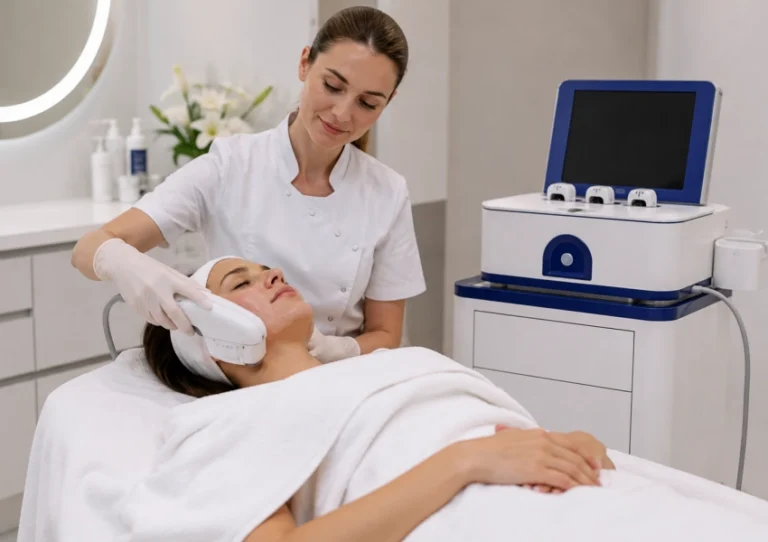
The MQLASER HIFU facial lifting platform should be quoted with exact probes, depths, frequency, energy range, interface, presets, training, warranty, and replacement route. The HIFU equipment frames nearby configurations, while the
MQLASER is only portfolio context. MQLASER supports eligible OEM/ODM and project configuration with an experienced R&D team; the company states that 15% of annual revenue goes to new-product development. Ask for CE, ISO, RoHS, and destination-market documents for the exact model.
For a distributor or multi-site group, the MQLASER project support team should document probe supply, training language, spare parts, remote support, and localized interface or appearance work. The relevant advantage is a verifiable package, not a blanket claim that one platform is better. If you would like to learn more, please read this article.
Conclusion
Ultherapy PRIME may fit a clinic that values a defined branded pathway and current local visualization-led training. MQLASER HIFU may fit a clinic or distributor that needs a configurable face, neck, and possible body platform with room for OEM/ODM planning. The deeper decision is clinical: can the delivered system support the 1.5, 3.0, and 4.5 mm service map, the 60-90 minute room workflow, the delayed 3-6 month client timeline, and the follow-up discipline described in the HIFU handbook? Confirm those points first, then compare five-year cost and upgrade return.
FAQ
Q1: Which HIFU depth is most relevant for facial lifting?
A1: It maps 1.5 mm to superficial work, 3.0 mm to deeper dermal collagen work, and 4.5 mm to SMAS-level contour programs. Confirm probes and local operating scope.
Q2: Does Ultherapy PRIME automatically provide a faster ROI?
A2: No. ROI depends on local pricing, completed bookings, room time, training, transducer cost, maintenance, and the value of the platform’s positioning and workflow.
Q3: What should a clinic test in an HIFU demonstration?
A3: Test depth selection, visualization or mapping, probe recognition, gel contact, handpiece movement, program changes, fault handling, records, cleaning, and room reset.