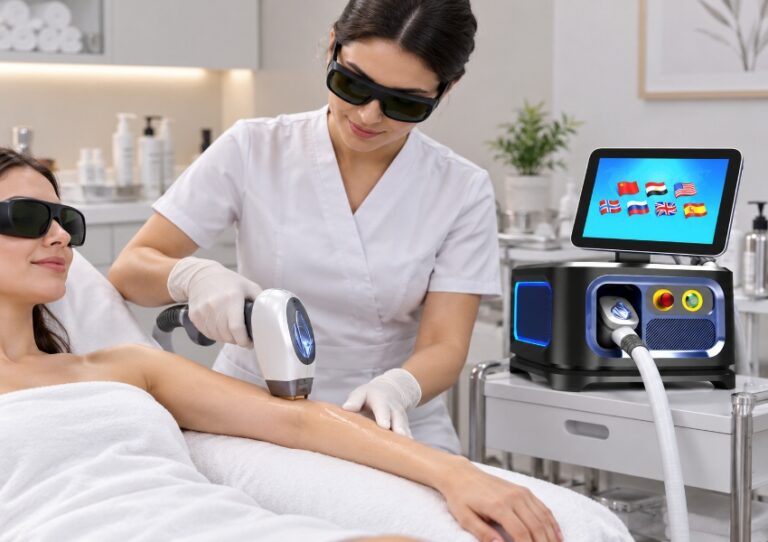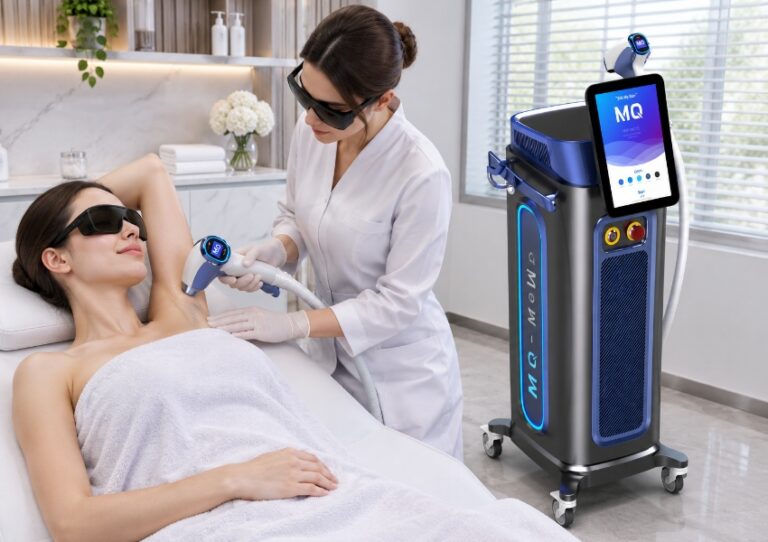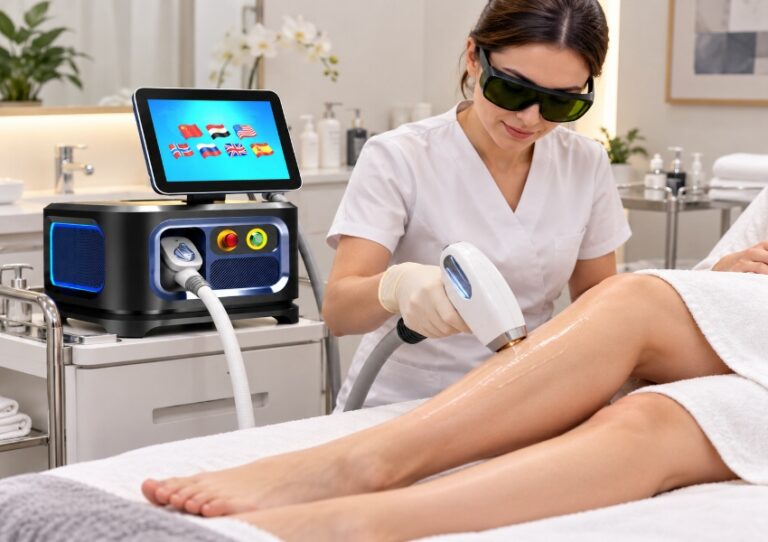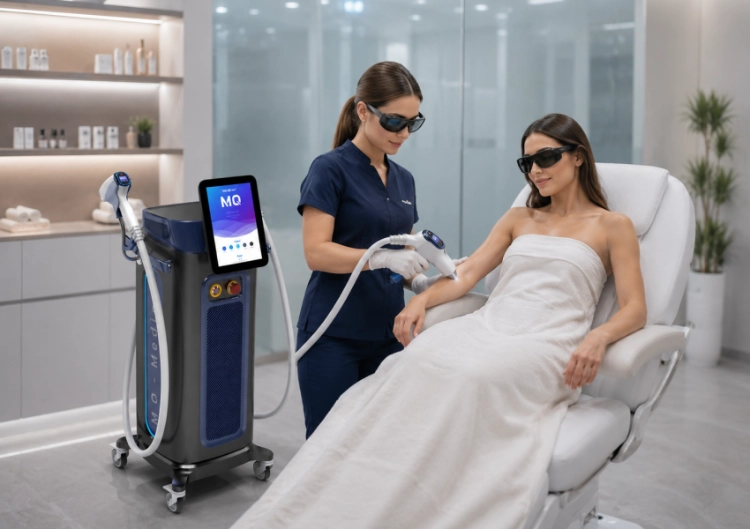
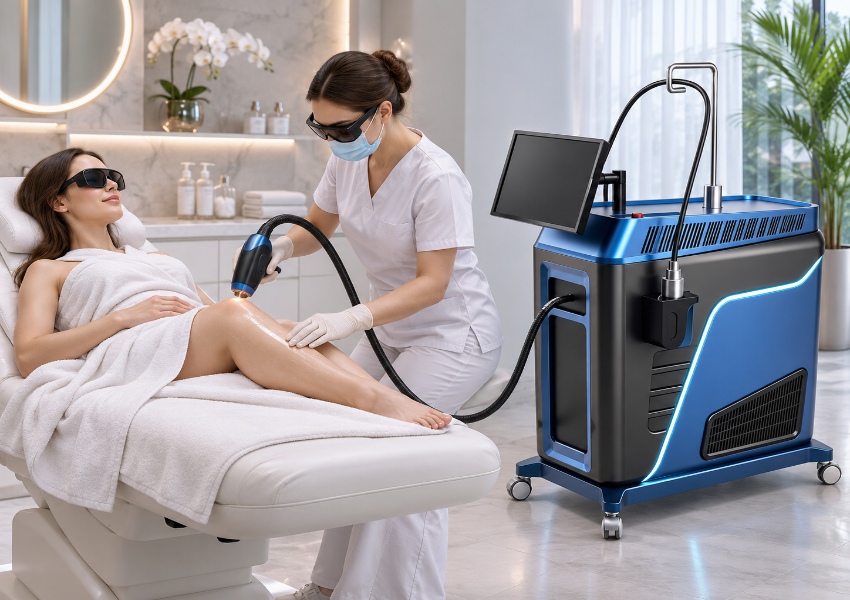
Having a larger laser spot decreases placements in any area that is dense, like the leg or back, but it doesn’t equal faster clinic. Consultation, shaving or preparation, eye protection, map arm firing, cooling pauses, handpiece repositioning, storing, cleaning photographs, aftercare room reset A tiny dot might take a longer time over an entire leg but is more precise on the upper lip, ears, fingers, ankles, or bikini edge. It is not large spot versus small spot—this decision you can make before such a scene ever starts. It is about which spot range works for the daily menu.
AlexPlus is a 755 nm Alexandrite channel, a 1064 nm ultra-long-pulse Nd:YAG channel at a maximum 26 mm spot on the latest Plus configuration, and DCD dynamic cooling. These provide a realistic context for questioning how your handpiece behaves under an actual appointment instead of thinking that some published maximum spot will dictate throughput.
Coverage Area Is Only One Part of Speed
A spot covers more surface per placement and can be helpful on flat, broad surfaces like the back, thighs, lower legs, chest, or arms. Abiding by a consistent pattern may reduce the number of placements and lower the possibility that small untreated gaps will lead to instability. If the handpiece is difficult to angle, cooling necessitates regular breaks, or operatives have to stop often for contours and bony edges, then practical gain can be lost.
When a Large Spot Helps
Only after the client assessment and device protocol determine a specific pathway of wavelength, pulse & energy; use only the largest spot that is indicated. Divide a large area into zones so that the operator can stay in contact to keep new ideas overlapping with consistency and document what was treated. The test demonstration must be to measure the entire leg time on a representative limb or back, not just the number of laser pulses. Preparation time for records, firing time with the absence of any cooling interruptions, client feedback record, and turnaround.
The AlexPlus 26 mm reference allows for coverage planning on such broad areas, and the other two channels are targeted towards skin scenarios (755 nm) & hair case scenarios (1064 nm). Verify that the handpiece, fiber, and applicator package match up with the specified spot range. If the latest local team can’t produce reliable contact and smooth pacing through a late-day schedule, then it’s just as much of a zero in any brochure proudly displaying that number.
When a Small Spot Is Faster
Spot sizes are even more efficient where the treatment area is narrow, curved, sensitive, or high optical density. The facial margins, the jawline, the upper lip, the fingers and toes, and the bikini edge are NOT little legs. A more accurate spot minimizes weird retargeting and accidental overlap. It is also useful for an operator when separating areas with varying hair density or skin response. Not to be as small a spot on this condition; only not the use of a tool range greater than that must make an appointment slower for the tenth area.
The Handpiece Determines the Pace
On top of this, the handpiece also can limit laser hair removal speed. All of these—weight, cable flexion, grip style & comfort, screen responsiveness, and raw-to-fiber volume ratio—ominically deliver cool and readily clean surfaces. Contact window cleanup reset behavior generally takes its toll on the operator over time. The staff that will be delivering the services should complete a purchase demo. The notes they take can show weariness or uncomfortable reach that a sales demo never will.
Use DCD and Cooling Deliberately
Cryogen is imbedded at a different dose of DCD dynamic cooling than the laser pulse, or using other methods. Cooling appears to influence comfort and epidermal protection, especially with stronger parameters. It also changes timing. You need to know how fast a cooling cycle runs, what type of consumables and maintenance are involved if the cryogen supply needs care and management during use, and how does the machine logs faults. However, a faster firing rate can be of scant use if the room turnover halts to effect cooling-related resets.
Where you have a spot size, more should be in the treatment record. Record the channel, spot, pulse, fluence, and cooling configuration at the body area/passage/client sensation or based on some endpoint as well as any interruption. This lets the clinic objectively compare a 26 mm leg protocol to an authentically smaller spot facial one. It also distinguishes between a handpiece issue, a training concern, and an over-scheduling problem for managers.
Measure a Complete Appointment Before Buying
Let me give you a quick time sheet for all four combinations: underarms, lower legs, full back, and small facial area. Check-in/photos preparation; treatment; clean-down: aftercare room reset use the same operator across each demonstration with uninterrupted booking rules. Under permitted demonstration conditions, if the practice boasts a balanced patient demographic mix, you can sample many skin tones and hair calibers.
Speak to the supplier about delivered configuration, spot range, pulse optionalities, cooling method (specification of air-cooled, water-cooled, or other), handpiece warranty covering how many shots for what price on all fiber and cable service processes, and weighing if it is a simple replacement part such as not needing recalibration before being used again in certain circumstances at home. The Alexandrite and Nd:YAG platform is better considered as a platform than an individual spot-size claim.
Turn Spot Selection Into Better Service Design
Clients don’t book a 26 mm spot. They define a series of legs, back facial space, or hair reduction classes. Create localized service pages and scheduling descriptions specific to those regions, anticipated prep time and consultation components, as well as practical review practices. This proves particularly beneficial to AlexPlus, since the device also features patented Nd:YAG applications that allow for a wide spectrum of authorized treatment options, including diffuse redness, selected vascular aspects, and therapeutic facial care, as well as aesthetic nail services. Each service should have its own training, local compliance review, and communication rather than just being added to the menu of hair-removal services by default.
A good, well-run clinic can make a wide-area menu feel fast without creating urgency. Establish zone maps, inspect the handpiece before proceeding with its first booking in a working day, and ensure that expendables are on standby as well—ensure you have good buffer time for proper cleaning/aftercare. MQLASER and contact team are able to explore configuration/training needs. The correct purchase is one that retains honest treatment at the last appointment of a working day, not just about the demo design.
Conclusion
A big area can reduce coverage on wide areas. It relies on a small spot that simply serves to prevent wasted motion in the detailed areas. Neither wins every appointment. Collect data continuously from the real package measuring full room time, handpiece behavior, breaks in cooling, client comfort, and operator fatigue. That is a far better buying decision than comparing just the spot diameter of either.
FAQ
Q1: Does a large spot always make hair removal faster?
A1: No. It can improve coverage on large flat areas, but contact, cooling, handpiece handling, contours, and room turnover determine real speed.
Q2: Why use a small spot for facial hair?
A2: It can improve edge control and access around curved or narrow areas, reducing awkward repositioning and unintended overlap.
Q3: What should be included in a timing demonstration?
A3: Measure consultation, photographs, preparation, treatment, cooling pauses, cleaning, aftercare, and the time needed to reset the room.