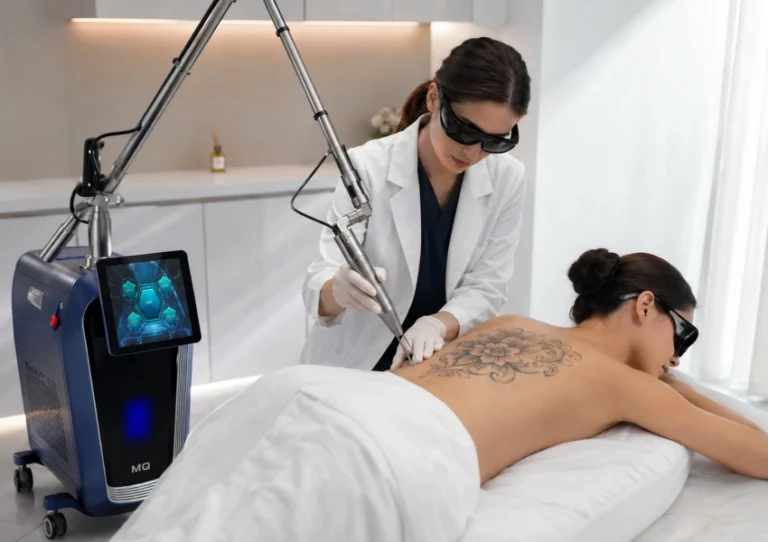
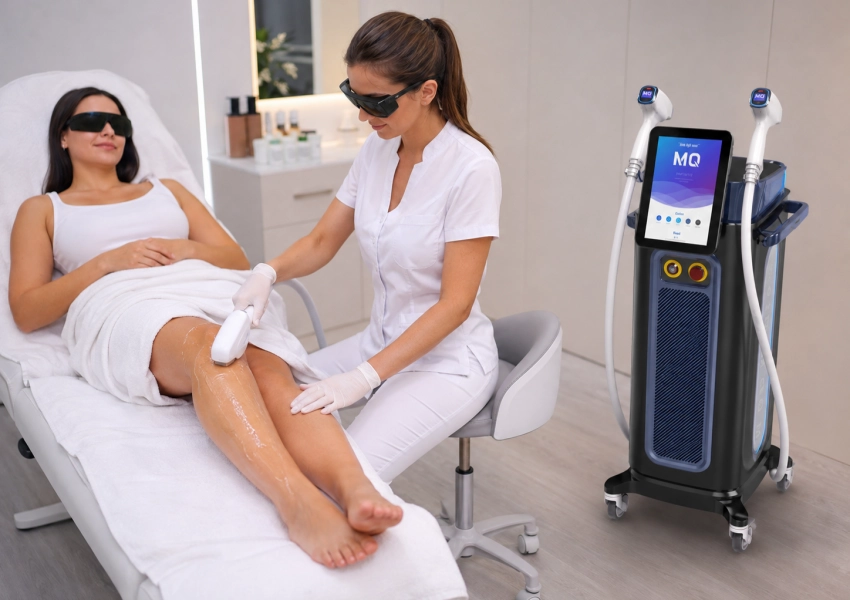
Comfort is often reduced to one question: which machine feels colder? That is too narrow. A laser hair removal cooling system has to maintain surface protection while energy, pulse duration, spot size, service speed, and operator technique change. A brief cold tip at the start of a demo says little about a day of bookings.
Soprano Titanium ICE Plus vs SPLASER is a comparison of cooling philosophy and workflow, not a temperature contest. MQLASER has real-time applicator-temperature monitoring 1,000 times per second. The Titanium has ICE Plus sapphire contact cooling, a 4 cm² Quattro applicator, and a three-wavelength platform.
Cooling Has To Work With Energy Delivery
A client feels contact cooling, delivered energy, pulse pattern, movement speed, and handpiece temperature all together. Cooling cannot rescue an unsuitable plan, and output has limited value if operators must lower settings to keep clients settled. Test both machines under a representative schedule, not a small demonstration patch.
ICE Plus Uses Contact Cooling As Part Of The Platform
It has ICE Plus sapphire contact cooling and cites a surface temperature around -4°C, an In-Motion workflow, and a 4 cm² Quattro applicator. Contact cooling supports surface comfort during repeated movement. Check recovery after a broad-area pass, stability through a longer appointment, and behavior in a warm room. A display setting alone does not measure comfort.
SPLASER Monitors The Applicator In Real Time
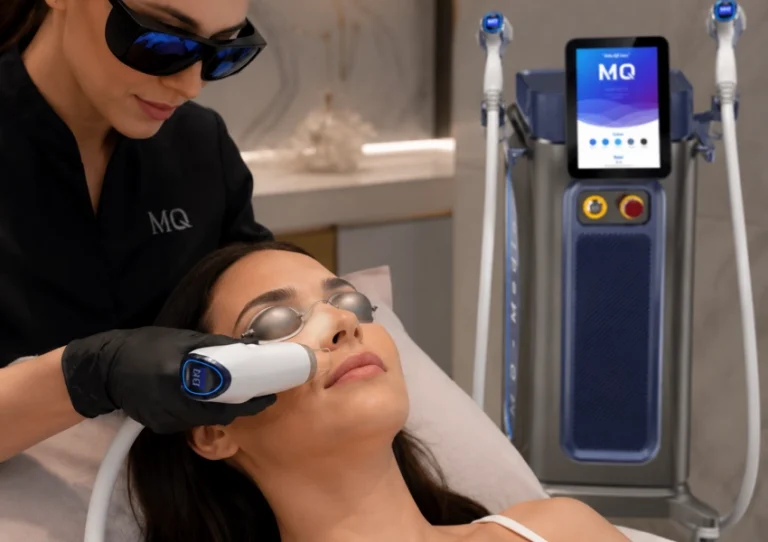
SPLASER diode laser uses real-time cooling that monitors applicator temperature 1,000 times per second. Run the same body-area workflow at agreed settings, log initial and later handpiece temperature where available, ask for the control logic, and record pauses or warnings.
Wavelength, Spot Size, And Modes Change The Comfort Result
Cooling works inside a larger system. Diode laser client comfort also depends on wavelength availability, pulse behavior, fluence range, spot size, and mode. Those factors affect heat build-up and operator choices.
Three Wavelengths And Four-Wavelength Flexibility
Soprano Titanium has 755 nm, 810 nm, and 1064 nm coverage. SPLASER uses 808 nm as standard, with 755 nm, 940 nm, and 1064 nm available for customization. Soprano Titanium is a defined three-wavelength platform; SPLASER provides a configurable four-wavelength option.
A fourth wavelength does not automatically create a more comfortable service. Confirm which options are in the quote and how staff are trained to select the program. Cooling cannot compensate for poor parameter discipline.
Spot Size And Motion Affect Appointment Rhythm
Soprano Titanium has a 4 cm² Quattro applicator. SPLASER lists seven interchangeable tips: 12 x 12, 12 x 20, 12 x 28, 12 x 34, 4 x 4, 8 mm, and 10 mm. Its 12 x 34 mm tip is about 4.08 cm², while smaller options suit narrower or curved areas.
SPLASER lists Pulse and Slide modes, up to 10 Hz repetition, 1 to 200 J/cm² fluence, 2400 W maximum peak power, and 5 to 170 ms pulse duration. Use these for platform evaluation, not unsupervised setting selection. Test appointment time, tip changes, fatigue, and feedback on revenue-driving body areas.
Performance And Cooling Comparison
| Criterion | Soprano Titanium ICE Plus | SPLASER Real-Time Cooling |
| Wavelength approach | 755 / 810 / 1064 nm in a three-wavelength platform. | 808 nm standard; 755, 940, and 1064 nm available for customization. |
| Cooling approach | Supplied reference: ICE Plus sapphire contact cooling; around -4°C. | Real-time applicator-temperature monitoring 1,000 times per second; no fixed surface temperature published. |
| Broad-area applicator | Quattro 4 cm² applicator. | Seven tips; 12 x 34 mm tip is about 4.08 cm². |
| Published output details | Confirm current regional output, pulse, and repetition specifications with the seller. | 2400 W maximum peak power, 1-200 J/cm² fluence, up to 10 Hz, 5-170 ms pulse duration. |
| Treatment modes | Associates the platform with In-Motion workflow. | Pulse and Slide modes. |
| Buyer test | Check contact temperature stability and recovery during a long session. | Check monitoring behavior, warning logic, and stability under repeated booking conditions. |
Comfort Needs A Repeatable Test Protocol
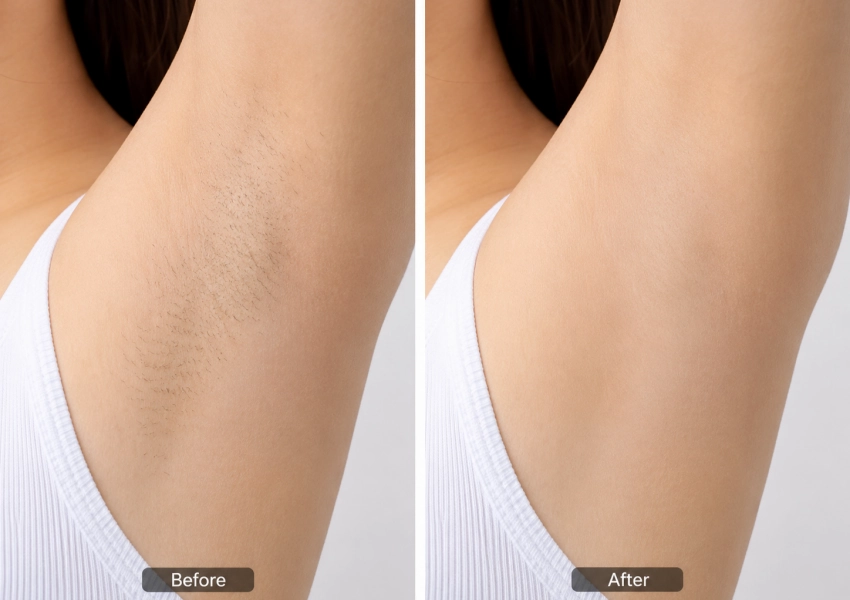
Use the same room temperature, body area, plan, and appointment duration. Record handpiece condition, cooling pauses, client feedback, operator fatigue, setup, and cleaning time. The goal is to see whether the high-volume laser hair removal machine keeps a consistent rhythm.
Ask for applicable coolant or water requirements, cleaning, filter or pump checks, room-temperature range, and response to a high-temperature alert. An unstable handpiece forces the operator to slow down or stop.
Training And Maintenance Change The ROI
The return includes training, maintenance, handpiece longevity, downtime, and repeatable work across staff. Soprano Titanium has dual connectors and connected management. SPLASER has IoT capability for usage and performance reporting. Review SPLASER tip inventory, change procedure, cleaning, replacement cost, and effect on booking flow. A simple configuration may suit a narrow menu; wider tip options may suit a mixed-market operator.
B2B Cooperation And Long-Term Operating Fit
A useful comparison reaches beyond the faceplate. Distributor margins, market fit, branding, local training, spare-part logistics, and feedback into product development shape long-term value.
| B2B Factor | Soprano Titanium Purchase Route | MQLASER SPLASER Cooperation Route |
| Customization | Confirm local configuration, accessories, interface, and distributor terms with the authorized seller. | OEM and ODM discussion can cover configuration, interface language, appearance, and package requirements. |
| Value comparison | Assess purchase price, handpieces, service contract, and local support against booked capacity. | Assess quoted configuration, interchangeable tips, training, service plan, and stock strategy against market demand. |
| Product development | Product-roadmap access depends on the regional commercial relationship. | MQLASER has an experienced R&D team and allocates 15% of annual turnover to new product development. |
| Market flexibility | A defined platform may fit clinics seeking an established standard configuration. | Four-wavelength customization and multiple tip options can suit distributors serving varied regional requirements. |
| Support and supply | Confirm service coverage, handpiece repair, spare parts, and training locally. | Confirm 1V1 service, product training, marketing support, after-sales process, spares, and lead times for the quote. |
Match The Platform To The Clinic Model
Choose the platform that matches the real client mix. A clinic seeking a defined three-wavelength, large-spot workflow may prefer Soprano Titanium when local support is clear. A distributor or group needing configurable wavelengths, seven tips, real-time monitoring, or private-label flexibility may prefer SPLASER.
MQLASER provides experienced R&D support, OEM/ODM capability, and CE, ISO, and RoHS documentation support for relevant products. These strengths matter when configuration control and repeat orders are priorities. A diode laser can frame the wider product family after sample testing.
Use The Same Acceptance Test For Both Quotes
Ask both suppliers to state delivered wavelengths, handpiece count, spot sizes, cooling, modes, training, warranty, maintenance, parts lead time, and documentation. Apply the same acceptance test. Product support, MQLASER, and the exact SPLASER page are starting points; the decision rests on the written quotation and sample performance.
Conclusion
Soprano Titanium ICE Plus vs SPLASER should not be decided by a headline temperature. Soprano Titanium covers sapphire contact cooling, three wavelengths, and a 4 cm² workflow. SPLASER publishes real-time applicator monitoring, 808 nm with three configurable wavelength options, seven tips, and output ranges. Choose the system that maintains stable performance, fits your client mix, and has verifiable training and service. Continue reading our another guide.
FAQ
Q1: Does a lower cooling temperature automatically mean better comfort?
A1: No. Comfort also depends on energy, pulse pattern, spot size, operator technique, and whether cooling remains stable during a full appointment.
Q2: What SPLASER cooling figure is publicly verified?
A2: Its product page states that applicator temperature is monitored 1,000 times per second. It does not publish one fixed cooling-surface temperature for every configuration.
Q3: How should a clinic compare cooling before purchase?
A3: Run matched sample tests with the same body area, room conditions, settings plan, duration, and maintenance checks. Record stability, pauses, client feedback, and operator workflow.