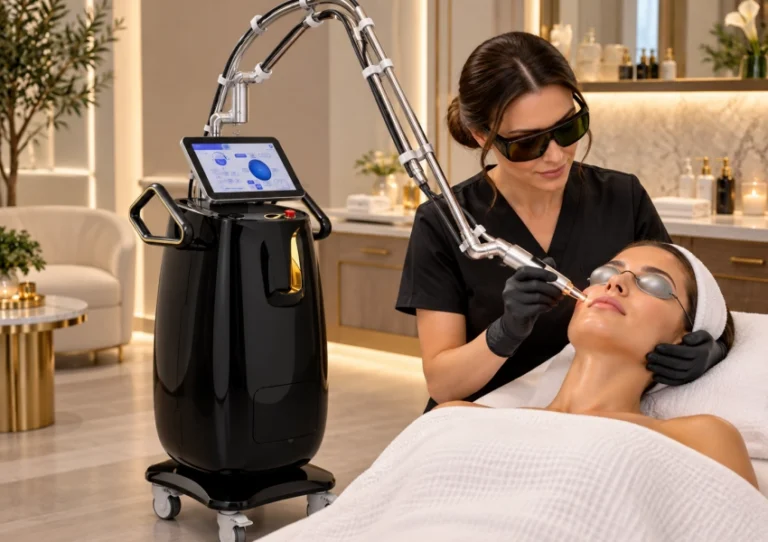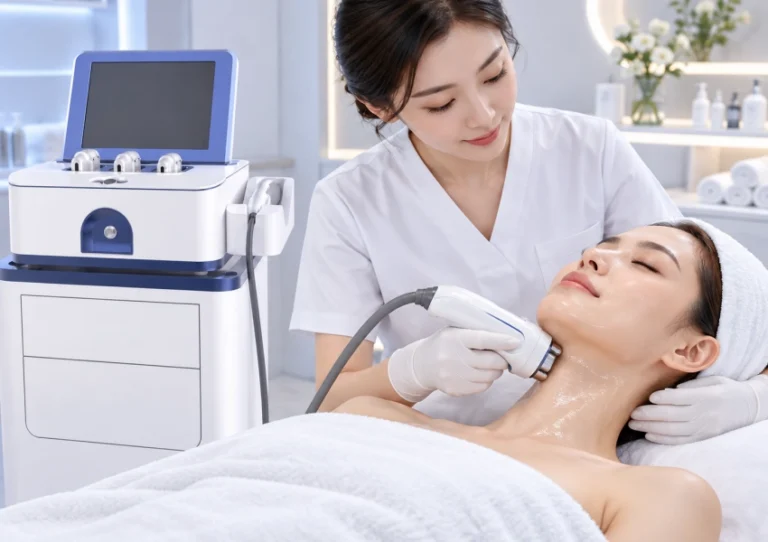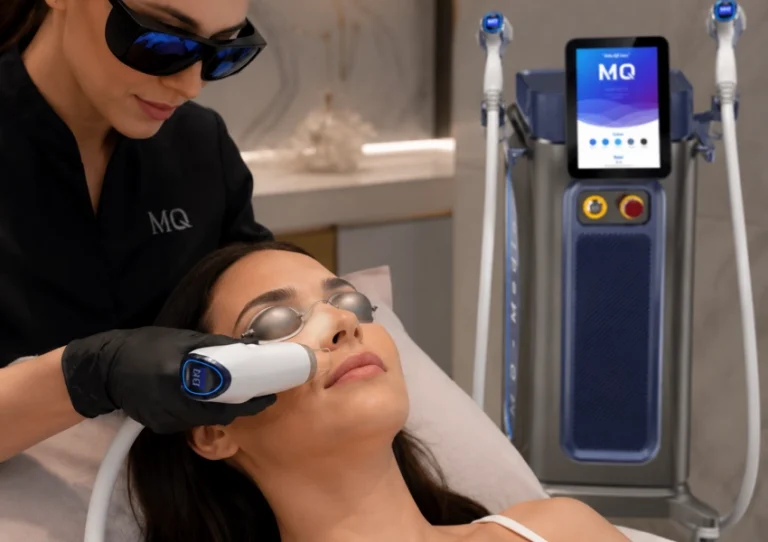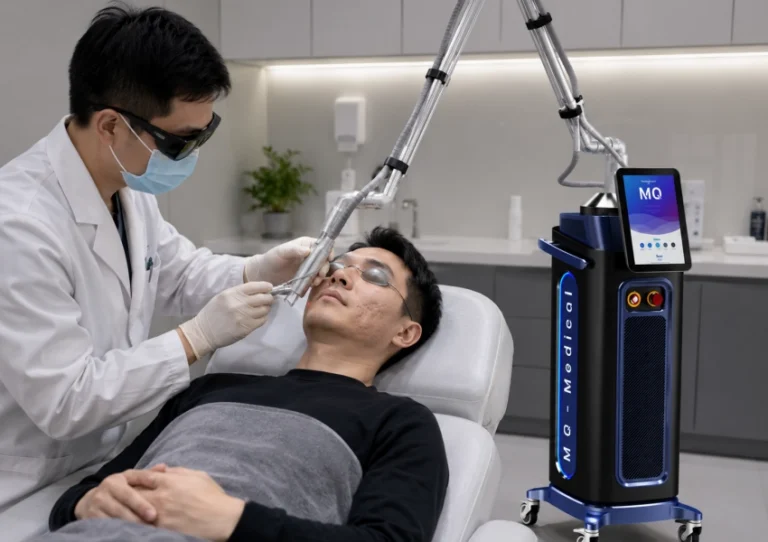
A facial lifting program earns its place through repeatable bookings, not a low cartridge quote. Clients buy a defined journey: face and neck assessment, selected depth plan, realistic timing, and follow-up. The HIFU machine ROI question is therefore clinical and commercial. The device must support the layers being sold, while the business model accounts for working time, probe use, training, and quiet months.
Start With The Facial Lifting Layers
1.5 mm for superficial epidermal and dermal work, 3.0 mm for the deeper dermis and collagen-rich zone, and 4.5 mm for the SMAS layer used in facial contour work. It has 6.0-13.0 mm for body contouring. A clinic should prove facial demand before buying a large body cartridge set.
Give Each Depth A Named Service Role
The 1.5 mm option can support lighter work for fine lines, texture, and visible pores. The 3.0 mm option is tied more closely to collagen remodeling, tightening, and elasticity. The 4.5 mm option supports contour-focused work around the jawline, cheek area, and neck when the device, training, and local rules permit it. Each depth needs a defined cartridge, energy range, area map, appointment time, and client explanation.
Build A Face And Neck Workflow
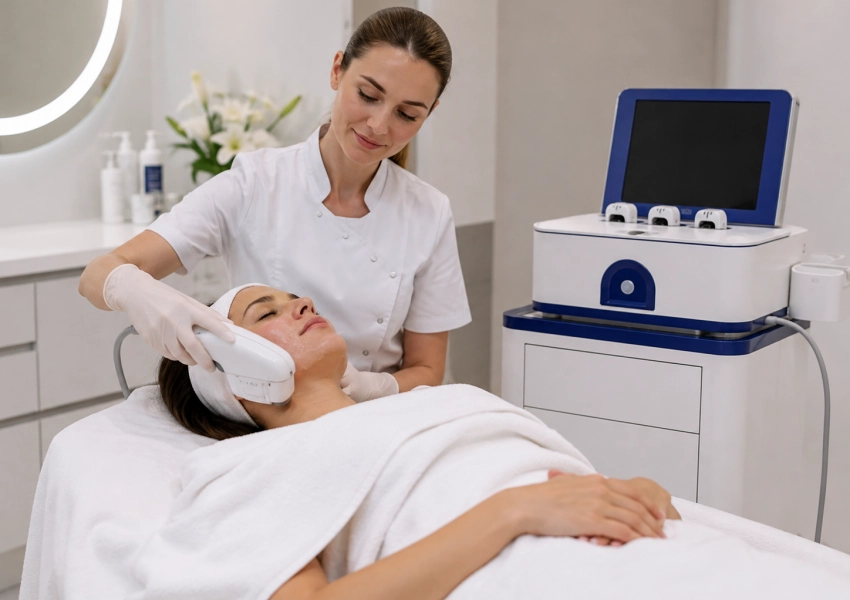
It has a typical HIFU session window of 60-90 minutes and identifies face, jawline, brow, and neck concerns as core demand areas. An appointment starts with front, side, and 45-degree photographs, followed by area review. The operator selects the focal depth, applies coupling gel, keeps the handpiece moving steadily, and avoids repeated high-energy delivery over one point. A face-and-neck package can raise the ticket but needs more room time.
Design The Program Around Realistic Change
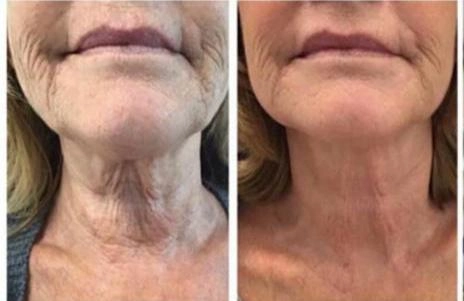
Facial HIFU is not a same-day revenue promise. It has thermal coagulation points at approximately 65-70 C, followed by a repair and collagen-building process that develops over 3-6 months. It places the visible peak around six months and describes a possible duration of 12-18 months. A clinic that sells this service should plan its follow-up and content calendar around that timing. The booking may happen today, while the strongest reason for a repeat visit is built over several months.
Use Consultation To Protect Service Value
A useful consultation explains gradual change, variable sensation, and possible temporary swelling or tenderness. The source material calls for consent, before-and-after records, and review of active acne, eczema, infection, pregnancy, implanted metal, pacemakers, unstable fillers, and relevant medicines. Local rules determine screening and delivery. These checks consume staff time and reduce unsuitable bookings.
Schedule Follow-Up Instead Of Chasing Frequency
It recommends reviews at one, three, and six months with repeat photographs. It places repeat facial sessions at a minimum interval of 6-12 months and warns against unnecessarily frequent use. A clinic should not forecast weekly repeat income from the same client. Sell a defined initial program, book review points, and avoid presenting an early photograph as the final outcome.
Calculate HIFU Machine ROI From Completed Services
The first calculation should use the clinic’s actual facial service, not a generic HIFU treatment cost. Start with the local price, then subtract probe allocation, staff minutes, room use, payment fees, approved consumables, photography, follow-up administration, and maintenance reserve. The remainder recovers the machine investment. Cartridge cost is only one line.
| ROI input | What to record | Why it matters |
| Service price | Actual local price for face, face-and-neck, or contour package | A package price changes contribution more than a brochure price does. |
| Session time | Usually 60-90 minutes; record the delivered workflow. | Longer room use reduces daily capacity and changes staffing cost. |
| Probe allocation | Purchase price, stated shot limit, focal depth, replacement lead time | A lower machine quote can carry a higher running burden. |
| Utilization | Conservative paid bookings per week and seasonal variation | ROI fails when a full calendar is assumed before demand exists. |
| Fixed and risk costs | Training, freight, finance, maintenance, downtime, and follow-up labor | A complete ownership view prevents false payback claims. |
Use A Three-Case Forecast
Use three cases. The slow case uses low bookings, a 90-minute session, full staff and room costs, and realistic probe allocation. The expected case uses the clinic’s current conversion rate. The strong case adds bookings only after training capacity and probe supply are proven. Payback is equipment and launch cost divided by monthly contribution, not equipment price divided by sales.
Protect The Denominator
The denominator should be completed, paid sessions. Cancelled appointments, demonstrations, complimentary sessions, and blocked room time do not recover the investment. 25-30 minutes is a high-speed reference for some platforms and 60-90 minutes as a standard session range. Treat these as planning references, then replace them with the delivered workflow during a demonstration. Record setup, photography, gel preparation, line delivery, cleaning, and room reset.
Position HIFU Against Other Face-Lifting Services
A facial lifting menu is stronger when each device has a clear job. HIFU is for focused energy at facial layers including the dermis and SMAS, with no incision and a short expected recovery window. RF microneedling addresses dermal work through needles and RF energy; fractional CO₂ is more closely associated with surface resurfacing and longer downtime. These services can complement one another, but one platform should not be presented as a replacement for every service.
Sell A Layered Menu Without Blurring Boundaries
HIFU can carry the structural lifting and contour conversation. A lighter RF service can address surface tightness, while skin resurfacing equipment can serve texture and fine-line programs. It describes combinations such as HIFU with superficial RF, HIFU with resurfacing, and HIFU with volume or muscle-focused services, with spacing between services set by the responsible professional and local requirements. For ROI, the point is menu separation: one room can generate more value when each service has a distinct reason to book.
Compare Client Value, Not Just Device Price
When comparing HIFU with another face-lifting device, measure service promise, room time, consumables, training, follow-up, and repeat interval together. The cheapest machine is not always the cheapest program to run. Adjustable depths may broaden the menu, while a focused system may be easier for a small team to train. Choose according to services the clinic can sell consistently.
Check The Platform And Supplier Before Ordering
The MQLASER HIFU facelift machine should be quoted with the exact facial probes, focal depths, energy expression, shot or line accounting, interface, training, warranty boundaries, and spare-part route. It uses 1.5/3.0/4.5 mm as the basic facial depth map and 6.0-13.0 mm for body contouring, but the delivered configuration must confirm which probes are included and how each is operated.
Use the HIFU equipment to review the product direction, then test the actual unit with the planned face-and-neck workflow. MQLASER is useful for portfolio context. The project support should not replace a model-level quotation listing probe price, stated life, lead time, training, service response, and local documentation.
Ask For A Complete Demonstration
The demonstration should cover photographs, consultation records, depth selection, coupling gel, a jawline or neck map, steady handpiece movement, program change, fault response, cleaning, and shutdown. Ask two operators to repeat the setup. Record the time from room entry to room reset. Also confirm whether programs can be labeled by area, whether the interface records the selected probe, and how a replacement head is handled after a fault.
Price Support As Part Of ROI
MQLASER can discuss OEM/ODM and project-level configuration for eligible orders. An experienced R&D team supports product development, with 15% of annual revenue directed to new products. For a distributor or multi-site clinic, that may create room for localized interface, probe combinations, service materials, or package design. Ask for the exact commercial scope in writing. CE, ISO, RoHS, and any destination-market registration documents must be checked for the specific model and market rather than assumed.
Conclusion
A useful HIFU machine ROI model begins with the facial service itself. Map 1.5, 3.0, and 4.5 mm options to defined areas and programs, schedule the 60-90 minute workflow honestly, explain the 3-6 month collagen timeline, and use 6-12 months as the repeat-planning boundary described in the handbook. Then add probe allocation, staffing, room time, follow-up, training, maintenance, downtime, and conservative demand. This gives the clinic a commercial decision based on a real service, rather than on cartridge cost alone. For more detail, see our guide on this article.
FAQ
Q1: What is the most important input in an HIFU machine ROI model?
A1: Use completed paid facial sessions and contribution per session. Include local price, 60-90 minute room time, staff labor, probe allocation, follow-up, maintenance, and conservative utilization.
Q2: Which HIFU depths are commonly used for facial lifting programs?
A2: The handbook maps 1.5 mm to superficial work, 3.0 mm to deeper dermal collagen work, and 4.5 mm to SMAS-level facial contour programs. Confirm the delivered probes and local operating scope.
Q3: How soon should a clinic repeat a facial HIFU session?
A3: The handbook describes a repeat interval of at least 6-12 months. Use the responsible professional’s assessment, the device protocol, client records, and local requirements.