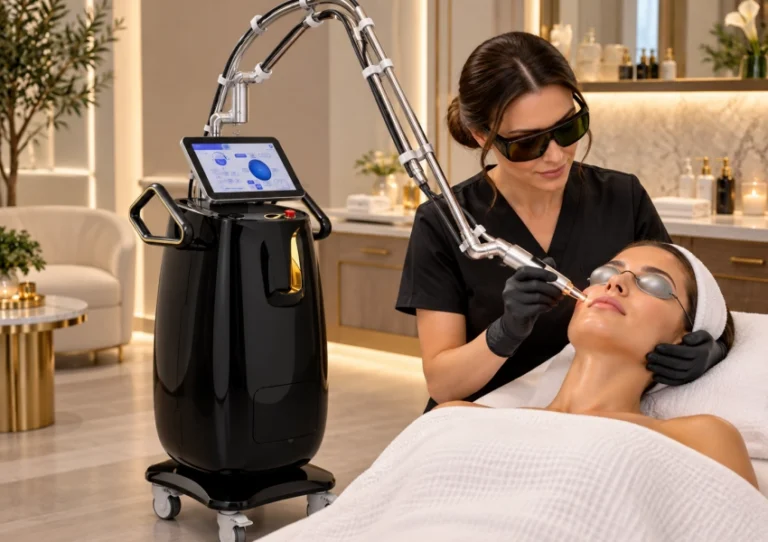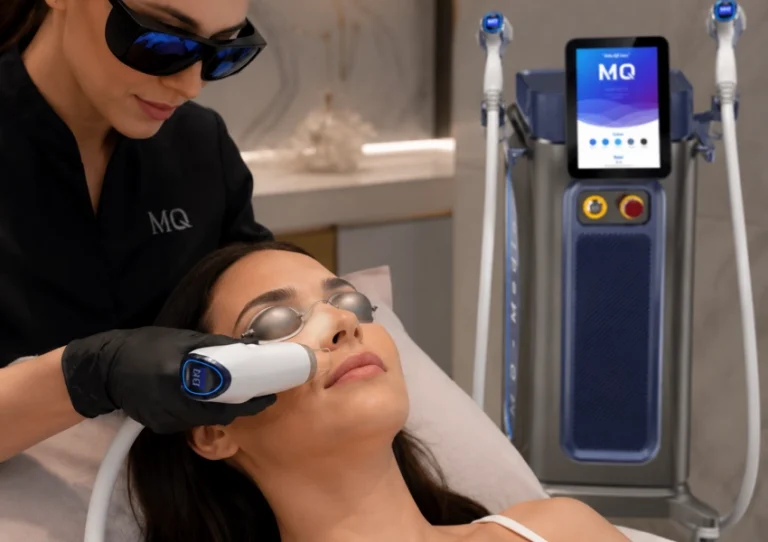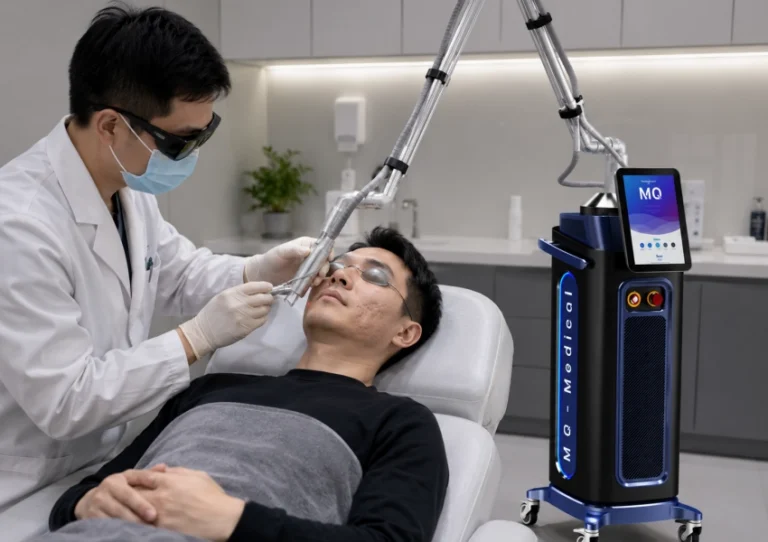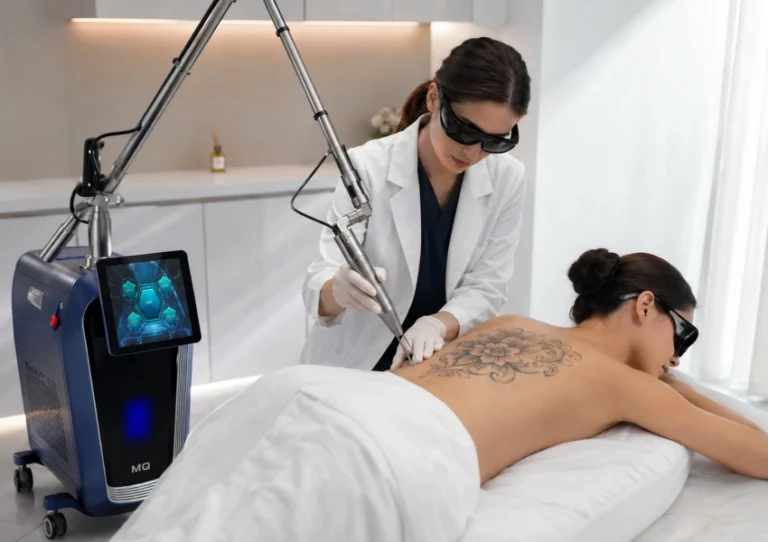
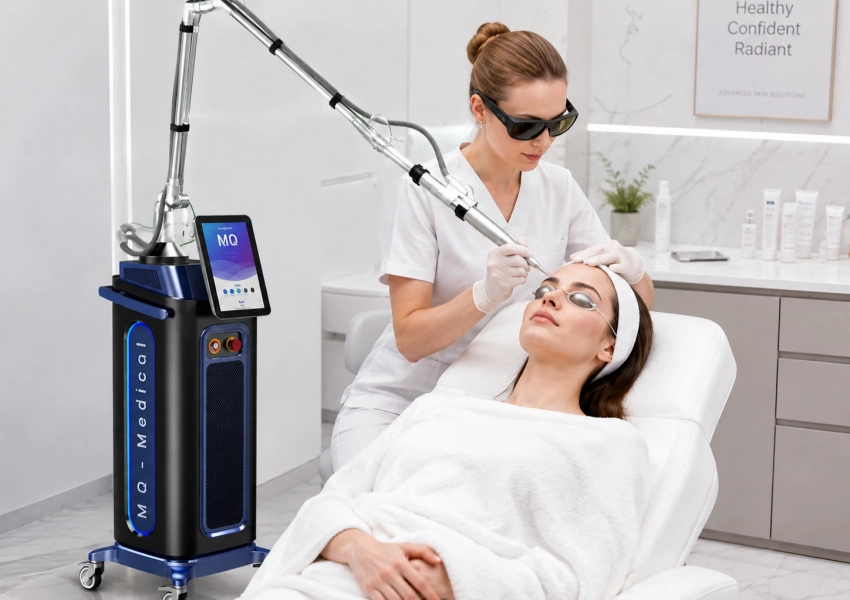
Acne scar clinics do not buy a fractional CO₂ laser only for headline power. They need a machine that can handle shallow texture, enlarged pores, boxcar scars, older depressed marks, and occasional deeper remodeling work without making every appointment feel like a high-risk recovery case. The better device is the one that gives staff control.
Lumenis vs DEPPLUS is therefore a comparison of treatment range, pulse behavior, scanning logic, recovery management, maintenance, and purchase economics. Lumenis UltraPulse and AcuPulse have strong market recognition in CO₂ platforms. DEPPLUS gives MQLASER buyers a fractional CO₂ laser machine built for adjustable acne scar programs and more flexible B2B sourcing.
Acne Scar Clinics Need Depth Control, Not Only Power
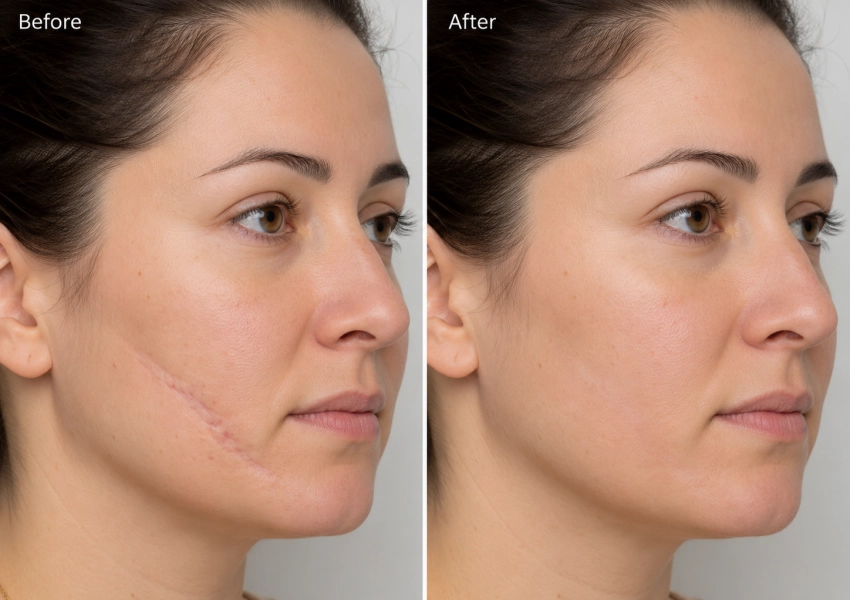
Acne scars are not one uniform problem. Some clients mainly need surface texture refinement, while others bring deeper atrophic scars or mixed pores, discoloration, and roughness. A clinic that wants stable outcomes needs a CO₂ platform with enough mode choice to step carefully between superficial and deeper work.
Scar Type Changes The Energy Strategy
Lumenis UltraPulse is widely associated with high-energy, short-pulse CO₂ work and deeper scar modes such as DeepFX and SCAAR FX. SCAAR FX reaches up to about 3.5 mm in a single pulse for scar revision. That depth can be valuable for selected severe scars, but it also demands strong operator experience and careful client selection.
DEPPLUS presents a more adjustable approach for beauty businesses: fractional working mode, cutting working mode, and other platform modes, plus UltraPulse, SuperPulse, and Continuous Wave options. For acne scar clinics, the practical advantage is being able to select shallow, middle, deep, or combo effects instead of treating every case with one aggressive pattern.
Recovery Time Affects Repeat Bookings
Acne scar service planning is also a recovery conversation. MQLASER DEPPLUS has a redness recovery around 3-5 days for some settings, while broader CO₂ recovery can run 7-30 days depending on depth and aftercare. That range should be presented honestly. Clients who accept downtime for deeper scars may still choose it; clients with work or travel schedules may need lighter sessions.
Performance Comparison: Lumenis And DEPPLUS
Modes, Depth, And Pulse Energy
DEPPLUS has a 10600 nm wavelength, a 70 W high-energy platform detail, plus power stability around +/-3%. It also has single pulse energy up to 240 mJ, adjustable depth from 1-4 mm, scan scope up to 20 mm x 20 mm, duration 0.1-9.9 ms, distance 0.1-2.0 mm, interval 0.1-2 s, and repeat 1-10. These are not decorative numbers. They help staff separate texture work from deeper acne scar remodeling.
The Lumenis reference positions UltraPulse as the high-performance option with up to 225mJ single-pulse energy and deep scar capability, while AcuPulse is a more general SuperPulse platform for common resurfacing needs. That makes Lumenis strong as a benchmark, while DEPPLUS deserves attention for flexible depth and cost control.
| Factor | Lumenis CO₂ Platforms | MQLASER DEPPLUS |
| Core positioning | UltraPulse is a high-end scar platform; AcuPulse is a versatile CO₂ workstation. | Fractional CO₂ system for resurfacing, acne scars, scar revision, pore texture, and rejuvenation-style programs. |
| Wavelength | CO₂ laser category, commonly 10600nm. | 10600nm fractional CO₂ laser. |
| Depth range | SCAAR FX reaches up to about 3.5 mm single pulse; AcuPulse is shallower for general work. | 1-4 mm adjustable depth supports shallow, middle, deep, and combo service planning. |
| Pulse / modes | UltraPulse, DeepFX, ActiveFX, TotalFX, and SCAAR FX are key premium references. | UltraPulse, SuperPulse, Continuous Wave, Sequence, Random, Continue, and Ultra Pulse scan modes. |
| Pulse energy | UltraPulse single pulse energy up to 225mJ. | Single pulse energy up to 240mJ. |
| Recovery planning | Deep scar modes can involve longer visible recovery. | 3-5 day redness recovery for selected settings; broader CO₂ recovery may be 7-30 days depending on depth. |
Scanning, Spot Quality, And Daily Workflow
Daily acne scar work depends on scanning quality as much as output. DEPPLUS uses a 360-degree light-guiding arm, a stable optical path, Smart Spot, and original Spiral Pattern technology. Combo mode can release dot and spiral line scans in one shot, helping staff design different resurfacing levels.
For a clinic doing many acne scar consultations, that workflow matters. Operators need to move from cheek texture to localized deeper scars without switching devices. A fractional CO₂ laser machine with adjustable scanning, a aiming beam, and stable delivery reduces avoidable variation.
Procurement And Maintenance Details Buyers Should Check
The second buying layer is less glamorous but often more expensive over time. Tube type, calibration, cooling, training, consumables, service response, and software usability all affect whether a CO₂ platform remains profitable after the launch month.
Tube Choice And Stability
DEPPLUS supports USA Coherent metal RF-excited tube and glass laser tube options. It has a stable optical path, a long lifespan, 70W high energy, and +/-3% power stability. The CO₂ manual also points buyers toward disciplined operation: trained users, clean treatment heads, optical cleanliness, ventilation, dust control, water circulation, suitable working temperature, humidity control, and regular calibration.
Those maintenance points are not small details. CO₂ laser acne scar treatment relies on predictable energy delivery. Before buying any acne scar laser equipment, ask how the supplier handles tube replacement, cooling guidance, calibration support, and service documentation.
Software, Training, And Service Cost
A premium device can carry a strong reputation, but reputation does not train new staff by itself. DEPPLUS includes Android-style operation, client file storage, remote software update potential, and custom interface discussion. Software clarity can reduce training time and make setting records easier to review.
MQLASER supports OEM/ODM and project customization, including software interface, appearance, and technical parameter discussion for buyers with defined needs. That matters for distributors and chains. If your business model depends on several machines and consistent staff training, supplier flexibility may be as important as the first unit’s laser output.
Where DEPPLUS Fits In A Growing Acne–Scar Business
The best purchase depends on clinic type. A top-tier scar center may want the premium recognition and specialized depth associated with a Lumenis platform. A growing acne scar clinic may need a wider balance: flexible settings, sensible recovery communication, manageable cost, and supplier support that can move with the business.
High-End Reference Versus Factory-Direct Flexibility
Lumenis has strong authority in fractional CO₂ and scar revision. That can help a clinic selling advanced, high-priced scar programs with expert operators. The tradeoff is usually higher acquisition cost and a more brand-controlled purchasing route, which can limit room or branch expansion.
DEPPLUS fits buyers who want a fractional CO₂ laser for acne scars with adjustable 1-4 mm depth, up to 240 mJ single pulse energy, Smart Spot, Spiral Pattern, multiple scan modes, tube options, and stronger cost-performance. It suits clinics and distributors building acne scar programs without making every service a flagship procedure.
Customization And Support For Channel Buyers
The second comparison table looks at B2B cooperation. MQLASER should be judged as a supplier, not only as a device name. Its experienced R&D team, 15% annual turnover investment in new product development, and CE, ISO, and RoHS documentation support matter once the device fit is clear.
| B2B Factor | Lumenis CO₂ Platforms | MQLASER DEPPLUS |
| Customization | Premium branded route, usually with limited private-label flexibility. | OEM/ODM can discuss interface, appearance, technical settings, and project materials. |
| Cost-performance | Strong for high-end clinics charging premium scar-program prices. | Stronger for buyers equipping multiple rooms or entering price-sensitive acne scar markets. |
| New technology cooperation | Updates follow the brand’s product roadmap. | R&D team and annual development investment support feedback-driven cooperation. |
| Market flexibility | Best for specialized scar centers and premium positioning. | Fits aesthetic clinics, salons, distributors, and mixed acne scar plus texture service menus. |
| After-sales and supply | Buyers should confirm local service, parts, and training access. | Training, documentation, OEM/ODM discussion, and supplier communication support channel rollout. |
Conclusion
Lumenis remains a strong reference in fractional CO₂ laser technology, especially for high-end scar revision. DEPPLUS is a serious alternative for acne scar clinics that need adjustable depth, up to 240 mJ single pulse energy, 10600nm CO₂ output, Smart Spot, Spiral Pattern, multiple scan modes, tube choices, and factory-direct flexibility. For buyers comparing Lumenis vs DEPPLUS, MQLASER makes the best case when service depth, budget, downtime communication, and supplier customization all affect ROI. Continue reading our another guide.
FAQ
Q1: Is DEPPLUS only for acne scar services?
A1: No. DEPPLUS supports fractional CO₂ resurfacing, scar work, pore texture, selected rejuvenation-style services, and cutting modes where local rules allow.
Q2: What DEPPLUS parameters matter most for acne scar clinics?
A2: Buyers should review 10600 nm output, 1-4 mm depth, up to 240 mJ single pulse energy, scan modes, tube options, and cooling stability.
Q3: When might a premium Lumenis platform still make sense?
A3: It may fit high-end scar centers that rely on strong brand recognition, expert operators, and premium service pricing.